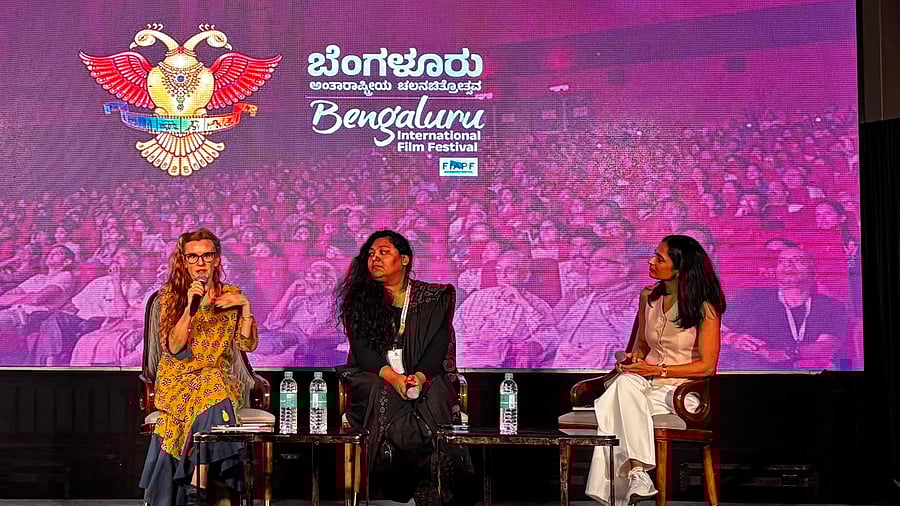
Credit: Special Arrangement
The panel discussion on women directors and the evolving language of cinema drew a packed audience on the sixth day of Bengaluru International Film Festival (BIFFes). The panelists delved into the systemic challenges women helming films face, and the restrictive ways female characters are written by men.
Nidhi Saxena, director of 'Secret of a Mountain Serpent' and 'Sad Letters of an Imaginary Woman', highlighted the deeply entrenched patriarchy on movie sets. "The environment is often such that men struggle to take direct or indirect orders from women directors. It is difficult to be taken seriously," she rued.
Nidhi noted that women are often forced to adopt aggressive personas to command respect.
"To be heard, we often have to let go of our femininity and be unnecessarily rude or even curse. Otherwise, we are expected to be extra polite and submissive. I have ended up firing many people simply because they refused to deliver what was required," she added.
Jacqueline Roussety, a German actress, director, and coach, observed that even in European cinema, strong female characters are often stripped of their womanhood.
"In German cinema, we have strong female characters, but they are often forced to be brutal and lose their 'femininity.' The male gaze has impacted women directors too; many end up directing women like men because that is the only template they know," Roussety explained.
She further argued that the industry relies on "tried and tested" methods that reinforce stereotypes. "Large-budget films are still almost exclusively in the hands of men," she noted.
Nidhi also critiqued the visual language used to depict women.
"Action and movement centre around men, but when it comes to women, the camera slows down to focus on seduction. Women are often broken into fragments, with ultra-close-ups on lips, belly buttons, and cleavages," she said.
Explaining the "Glass Ceiling" phenomenon, Roussety described it as an invisible barrier that prevents women from reaching the highest levels of the industry.
"Women artists can rise to a certain point, but eventually hit a ceiling that they cannot break through to grow further," she said.