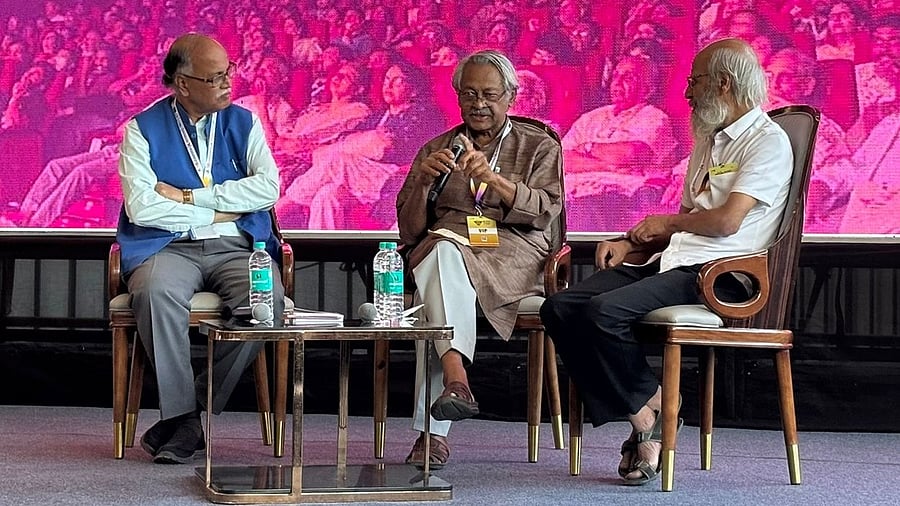
Acclaimed filmmaker Girish Kasaravalli speaks at BIFFes session titled ‘The Art of De-construction in Cinema,’ in Bengaluru on Sunday. Film experts N Vidyashankar (extreme left) and G S Bhaskar are also seen.
Credit: DH PHOTO
Bengaluru: Acclaimed filmmaker Girish Kasaravalli on Sunday emphasised that the true power of cinema was its ability to offer a democratic space for the viewer, rather than serving as a tool for emotional manipulation.
Delivering the V K Murthy Annual Memorial Lecture on “Film Construction and Deconstruction,” he traced the evolution of cinematic aesthetics over the last century.
He argued that the grammar of filmmaking had undergone radical shifts every 20 years, deeply influenced by the socio-political tensions of each era.
Reflecting on early cinema, Kasaravalli contrasted the “Analytical Dramatic School” of D W Griffith which prioritised emotional impact through close-ups with the Soviet “Montage School.”
“The Russians argued that cinema should not merely create an emotional effect but provoke intellectual engagement,” he said. “For them, it was about the filmmaker’s political questioning becoming apparent to the audience.”
Kasaravalli highlighted the transition to Neo-realism and the philosophical shifts of the 1940s, where filmmakers like De Sica and Rossellini sought to “make the viewer see beyond the surface.”
“In daily life, we see but we do not notice. Neo-realism forced us to go beyond the surface and understand the reality within the frame,” he observed.
Turning to contemporary aesthetics, he discussed how masters like Tarkovsky and Ozu utilised “time” as a primary element. He noted that unlike literature or painting, cinema is the only medium that can effectively use “real time” as its core material.
In a tribute to the man who shaped the grammar of film education in India, Kasaravalli walked down memory lane to celebrate the centenary year of Professor Satish Bahadur.
Speaking at a session titled ‘The Art of De-construction in Cinema,’ Kasaravalli credited the late academician with transforming him from a “clean slate” into a filmmaker who understands the profound architecture of the film.
The session, which featured insights from N Vidyashankar and G S Bhaskar, delved into Bahadur’s tenure at the Film and Television Institute of India (FTII), where he pioneered the discipline of Film Appreciation.
“When I joined FTII, I was a boy totally unexposed to cinema,” Kasaravalli reminisced. “Professor Bahadur didn’t just talk about the sociopolitical content which he felt could be learned from history books, but he taught us how a film is constructed. He was the father of film analysis.”
Kasaravalli highlighted Bahadur’s unique methodology of “shot-by-shot” deconstruction. Using examples like Satyajit Ray’s Pather Panchali and Vittorio De Sica’s Bicycle Thieves, Bahadur would spend days analysing a single sequence to show how space and time are manipulated to create an experience rather than just a narrative.
Kasaravalli observed a lack of “dynamism” in modern popular genres. He noted that while today’s films often move at a frantic pace, they frequently lack the internal tension and spatial awareness that Bahadur championed.