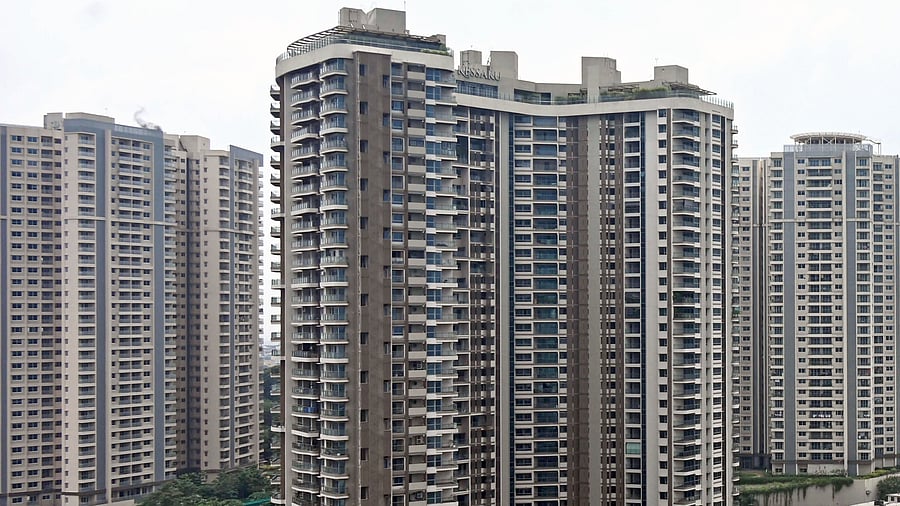
Representative image showing apartments in Bengaluru
Credit: DH PHOTO/BH Shivakumar
Bengaluru: Amid a growing demand for changes in the existing laws concerning apartments in Bengaluru, the government has finalised the Karnataka Apartment (Ownership and Management) Bill, 2025, which is likely to be tabled in the upcoming Winter Session of the legislature beginning on December 8 in Belagavi.
The bill seeks to establish an appellate authority for conflict resolution. This is different from the earlier laws, where the conflict resolution was internal and the parties concerned needed to approach civil courts for any legal relief.
The bill, which DH has accessed, applies to the projects containing eight or more buildings in Karnataka. It will replace the Karnataka Ownership Act, 1972. It could be discussed in the Cabinet meeting on Thursday.
As per the ‘Statements and Reasons’ of the bill, it seeks to provide a “mechanism for the governance of apartments, operation and use of common areas and facilities of apartment buildings”.
According to the bill, an allottee is one to whom an apartment has been allotted, sold or otherwise transferred by a promoter.
Common areas and facilities include staircases, lifts, staircase and lift lobbies, fire escapes, and common entrances and exits of buildings.
A promoter can refer to “a person who constructs or causes the construction of an independent building or a building consisting of apartments, or converts an existing building or a part thereof into apartments, for the purpose of selling all or some of the apartments to other persons and includes his assignees”.
The bill mandates forming an association of allottees representing all allottees for carrying out its provisions.
The proposed legislation seeks to form a competent authority, which will register and regulate the association of allottees or federations registered under the Act.
“The government may, by notification, appoint one or more officers of the local authority or the planning authority not below the rank of Group B, as the competent authority, to exercise the powers conferred on it and to perform the functions within the local limit as assigned to it under the Act.”
The bill bestows upon the competent authority the powers of a civil court.
Unlike the earlier laws — The Karnataka Societies Registration Act, 1960, and the Karnataka Ownership Act, 1972 — the new bill mandates uniform model bylaws and makes compliance under it mandatory.
“The association of allottees shall administer the affairs of the apartment and the property appurtenant thereto including the common areas and facilities, in accordance with the provisions of the Act and the bye-laws of the association of allottees,” the bill notes.
The bill seeks to establish an appellate authority for conflict resolution.
This is different from the earlier two laws, where the conflict resolution was internal, where the concerned parties had to approach the civil court for any relief.
As per the bill, one or more officers can be appointed as the first appellate authority but they must not be below the rank of Group A (Junior Scale). Any person aggrieved by an order or direction passed by the first appellate authority can approach the second appellate authority. The bill imposes a maximum fine of Rs 1 lakh on any promoter who fails to comply with it.