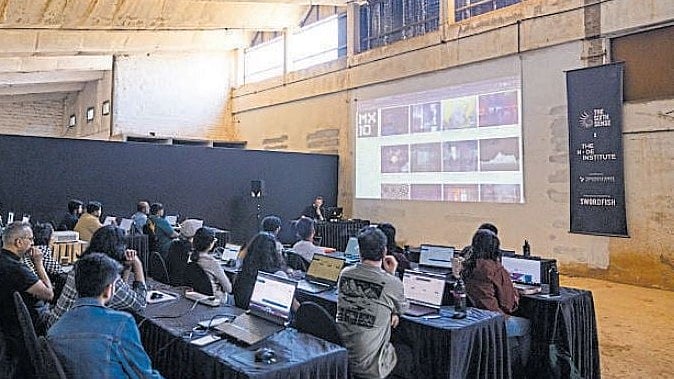
The Alembic Glass Factory was started post-Independence in Whitefield and shut about two decades ago. The repurposed venue is currently hosting a multidisciplinary festival of art, light, sound and storytelling.
Credit: Special Arrangement
Defunct factories and empty warehouses in Bengaluru are being reimagined as hubs for public engagement. After restaurants started moving into these industrial relics almost a decade ago, performance venues, museums, and malls are now following suit.
The people behind these projects admit that repurposing old structures is far harder than building from scratch. But they acknowledge the benefits: many of these factories sit on large parcels of land, often within green campuses, which is rare to find in Bengaluru today. They cite the example of cities like Berlin, London and Mumbai which boast a large number of old mills, godowns or power stations that now serve a completely different purpose. The Kochi Biennale is another successful example of adaptive reuse for contemporary needs, they add.
Old-world charm
On Thursday, a multidisciplinary festival themed on nature’s intelligence opened in Whitefield at a venue that was once the Alembic Glass Factory. “It started post-Independence as part of the industrial boom and shut about two decades ago,” shares Roshan Netalkar, founder and festival director of ‘The Sixth Sense’. The 18-day festival has incorporated the site’s legacy by using wires, cables, barrels, and switchboards in installations and decor. “Two art installations will be set inside the silo, a unit where glass used to be melted,” Netalkar adds.
Netalkar was “chasing the factory vibe” for the event, when, three years ago, he stumbled upon this 200,000-plus sq ft space. He was blown away by its openness and old-world charm, thanks to high ceilings, granite walls, and cement floors. What also helped is that the site, once on the outskirts, now has two metro stations nearby, which aligns with their mandate to reduce carbon footprint.
Apart from fixing water leaks and repairing dents in the flooring, the structure has been largely retained as is. He says the owner had already secured structural certification to ready it for another run.
Not always cheaper
A walk around Essensai067, a mall and cultural space that opened in Whitefield last April, reveals curious names — Luwa Street, Xorella Street, and Open End Street. These walkways are named after the machines and processes that once powered a spinning mill run by Sai Lakshmi Industries.
Somshekhar Mirpuri, cofounder and a member of the family that owns the facility, says they have retained much of the original 5.16-acre campus, from its columns and beams to over a hundred trees, including one planted to mark his birth. Contractors, he adds, were impressed by the strength of the walls and said these could support two additional floors. “The makeover involved refitting the existing structure, navigating old trenches common in earlier construction, and adapting modern building methods. We also reused excavated soil to create mud blocks, which went into the facade and structural binding,” he says.
Sustainability was a key driver behind the makeover. “It’s pretty much an open-air mall with no air conditioning in the common area, and while we have retained the old, we have added modern tech like solar power,” he shares.
Mirpuri clarifies that repurposing an old structure does not necessarily come cheaper than building anew. “It depends on what you want to do and how grand you want to make it,” he says.
Court rules
The government has also jumped on the bandwagon. The 105-acre campus in Baiyappanahalli, which once housed the New Government Electrical Factory (NGEF), is being transformed into a sprawling tree park and amenity hub.
And its 12,000 sq m switchgear factory shed will make way for India’s first startup and technology museum. The project, still in its early stages, is being developed as a public-private partnership between the department of electronics, and UnboxingBLR. The museum will trace Bengaluru’s role in placing India, once seen as a third-world country and a land of snakecharmers, on the global technology map.
The High Court has mandated that the existing structures and green cover cannot be removed, a directive that Malini Goyal, CEO of UnboxingBLR, is thrilled about. “Where else in Bengaluru can someone visit a museum after walking past a tree park with really old trees? Retaining the site’s natural heritage while building on it is a beautiful challenge for us,” she says. In the renewal of the NGEF campus, Malini sees the “renewal of the city itself and the experiences its public spaces can offer”. Adaptive reuse of old structures is the way forward for cities, she believes.
Praise for sustainability
Bangalore Creative Circus in Yeshwanthpur has drawn wide praise for its sustainable practices since it opened its doors in 2021. The community space was once a tile warehouse and, earlier, a steel factory dating back to 1980. When the founders first saw it, it resembled an aircraft hangar, with a few sheds on the side. The team was looking to rent a 3,000-5,000 sq ft space when one of their real estate developer friends invited them to come, look at this 20,000 sq ft facility.
“We are extremely proud to have created a forest-like patch on the base that was once entirely covered in concrete, with not a single blade of grass in sight,” shares cofounder Manisha Vinod. Alongside the core structure, the team retained the larger of the two gates, which was earlier used for loading and unloading goods. Today, it is used by trucks carrying large commissioned artworks, and to let huge crowds in during major festivals.
The venue draws about 2,000 visitors a month. Yet attracting people remains a challenge, as these factories were built on the far edges of the city, often away from main roads. “That’s why, in our communication, we always highlight that there is a metro stop and a mall nearby,” she says.
Not as straightforward
Restaurateur Anirudh Kheny says it is easy to get swept up in the romanticism surrounding old and historic buildings, but giving them a second life can be a “torturous job”. He is the managing partner of Suzy Q, a casual diner on Queens Road. It was earlier a Japanese-focused kitchen and bar, 1Q1, and before that, a printing press.
“For starters, there were no (engineering) drawings. We had to figure out the strength of the columns and beams and the load they could take. There were no records of electrical wiring, plumbing, or sewer lines,” he recalls.
He knew it wasn’t going to be an easy makeover but he had fallen in love with the abandoned property. When he first saw it in 2016, it was without compound walls and had open sewers, and vendors were selling secondhand clothes there. What stood out to him, however, was the double-height ceiling that rose to 25 feet and the sheer volume of the space. “Back then, Bengaluru had very few restaurants with such double-height structures. It reminded me of buildings from the 1950s and ’60s, and that is why we immediately connected it to the Art Deco era (and designed 1Q1 around it),” he says.
During the transformation, the team repurposed window frames and modified existing arches to suit the design. They resisted adding mezzanine floors, choosing instead to preserve the original double-height structure.
Layered history
According to Narayan Manepally, it is traces of the past that give a repurposed industrial property its charm, and this is evident at Geist Brewing Co, his beer garden restaurant and production brewery on Old Madras Road. When the team acquired the property in 2016, it housed a warehouse for a lifestyle brand. Before that, it had been a woodworking factory that manufactured MDF (medium-density fibreboard).
He recalls his first visit vividly. “When you entered the property, the front area was filled with hundreds of lemon plants. There is a reason the area is called Nimbekaipura. I also remember looking at the banyan and peepal trees on the site and telling my cofounder that one day we would have a beer garden under the canopy.”
At the same time, the original property was far too small for Geist’s needs and was never designed for brewing operations. The team had to expand it significantly, both lengthwise and breadthwise. With craft beer culture just catching on in Bengaluru at the time, they wanted to create a destination where customers could easily visit and engage with the brewing process. Given the site’s location, they decided the effort was worth it.
For Manepally, adaptive reuse encourages a deeper appreciation of a site’s layered history. It becomes a space that carries stories. “About five years ago, a visitor told me his father had worked in the woodworking factory here. We walked through the space together, and he pointed out where the machines used to be and where his father had worked,” he shares.