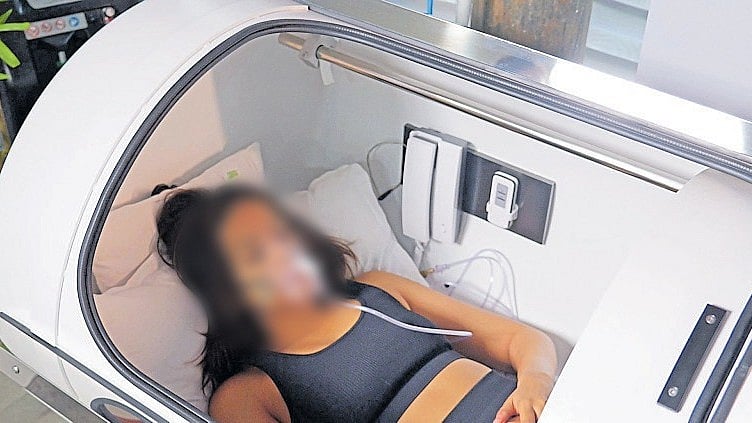
At a wellness clinic in Jayanagar, about 30% of HBOT clients are referred by doctors, while the rest opt for it voluntarily for general wellness.
Credit: The Wellness Co
Bengalureans are spending 50 minutes or more in pressurised chambers to breathe 100 per cent oxygen. While most are seeking recovery from medical conditions, a growing number are also embracing it for general wellness — to improve sleep, slow ageing, and inhale cleaner air. Some parents are turning to it, with a hope to boost their children’s memory for academics.
The treatment is called Hyperbaric Oxygen Therapy (HBOT). The pressure inside the enclosed chamber is typically 1.5 to 3 times the normal atmospheric levels, allowing more oxygen to dissolve into the bloodstream and reach tissues with poor circulation. The increased oxygen absorption is said to aid wound healing, fight infections, treat radiation injuries, counter carbon monoxide poisoning, and reduce brain fog.
In private clinics in Bengaluru, a session can cost upwards of Rs 4,000, with patients often needing eight to 40 sessions, sometimes five times a week, to notice results. According to Dr Syed Naveed Ahmed, a diabetologist, HBOT has existed for over a century, but its high cost had for long limited its adoption by the public. “It was mainly used by deep-sea divers and oil rig workers who were at risk of decompression sickness, and in military hospitals for combat-related injuries. Famously, Michael Jackson also owned one (this was after he suffered burns while shooting for a commercial),” he says.
But now doctors are seeing patients asking for HBOT, driven by greater health awareness post-pandemic, access to online information, and lately, an interest in longevity.
Complementary therapy
According to Dr Sumalatha K B, senior consultant in physical medicine and rehabilitation at a Hebbal hospital, HBOT is FDA-approved for 14 clinical conditions. She says it is not a standalone treatment, but a complementary therapy given alongside medications, and it can be stopped once the healing is achieved. At her hospital, three to four patients undergo HBOT daily, mainly for chronic wounds, radiation damage, sensorineural hearing loss, and traumatic brain injuries. She has also prescribed it to autistic children after stem cell therapy. However, she notes that emerging research is hinting at broader benefits of HBOT, including anti-ageing.
At a wellness clinic in Jayanagar, Metrolife recently spotted a young man reading inside an HBOT chamber, and it wasn’t his first session. “Metal objects, including phones, are not allowed inside the chamber (as they can pose a fire hazard),” says Dr Soundarya H K, associate doctor at the eight-month-old centre. About 70 per cent of the clinic’s clients come out of curiosity or to inhale pure oxygen as Bengaluru’s air quality is deteriorating, or to improve lung capacity, especially among smokers. Nearly 40 per cent of those who opt for IV drips for immunity, weight loss, or skin and hair treatments later try HBOT, as it “helps with better nutrient delivery”. The remaining 30 per cent are referred by doctors for medical conditions such as autism, diabetic ulcers, anaemia, gas gangrene, and Alzheimer’s.
The centre has two HBOT chambers and sees an average of two clients a day, including businesspeople, tech professionals, and athletes in their 30s and older. Among children, visitors include a six-year-old with ADHD, pre-teens with autism, and children aged eight to 13 brought in to improve memory. “For children who may not be fully comfortable alone in the chamber, we allow one parent to accompany them,” she says. Dr Soundarya says repeat visits are common, with many opting for packages of 11 to 12 sessions costing around Rs 40,000.
A decade since it opened, Dr Ahmed’s medical centre in HBR Layout has seen a diverse range of patients seeking 100 per cent oxygen therapy, from a top-ranking cricketer nursing from injury and aviation professionals with occupational hearing loss to a child in a coma, a doctor dealing with depression, and a couple in which one partner had chronic fatigue syndrome while the other suffered from stress-related skin pigmentation and sleep deprivation.
At the centre, HBOT is still used more for clinical conditions than lifestyle purposes, though footfalls related to the latter have been rising lately. Last year, a retired NRI from the US spent two and a half months in Bengaluru undergoing 60 sessions, hoping to lengthen his telomeres (the protective caps on chromosomes) to slow cellular ageing and reduce the risk of dementia. Men often seek HBOT to cope with irritability or the effects of smoking, while women tend to come for skin health and glow. Most clients belong to the upper-middle class. “Above all, people generally feel good and rejuvenated after a session,” he says.
For BPL families
Bengaluru’s Victoria Hospital is the only government facility in Karnataka offering HBOT, with a five-chamber machine. Sessions cost Rs 1,000 for BPL patients and double for others. It treats six to eight patients daily, with some travelling from Mysuru and Shivamogga. Dr Smitha Segu, nodal officer for HBOT, has seen encouraging results in burn, diabetic foot, and post-radiation necrosis cases. “It is heartening to see young children regain hearing after a sudden loss. We have also received a few psychiatric referrals,” she says.
Eligibility
While experts say HBOT is safe for anybody seeking general wellness, pregnant women, people at risk of lung conditions, cancer patients, and those with chronic sinusitis, seizures, claustrophobia, fever, ear pain, claustrophobia or a pacemaker are not deemed eligible. Dr Smitha says physicians must screen patients, and technicians must supervise the HBOT session.
Lastly, any safety concerns?
Dr Sumalatha says HBOT is given only at specific pressures and for set durations as per guidelines. Too much oxygen can cause toxicity or seizures.