
Credit: Special arrangement
A series of heritage walks on Saturday highlighted Bengaluru’s diverse and pluralistic history and culture. They were part of the ongoing BLR Hubba.
Faith and mysticism
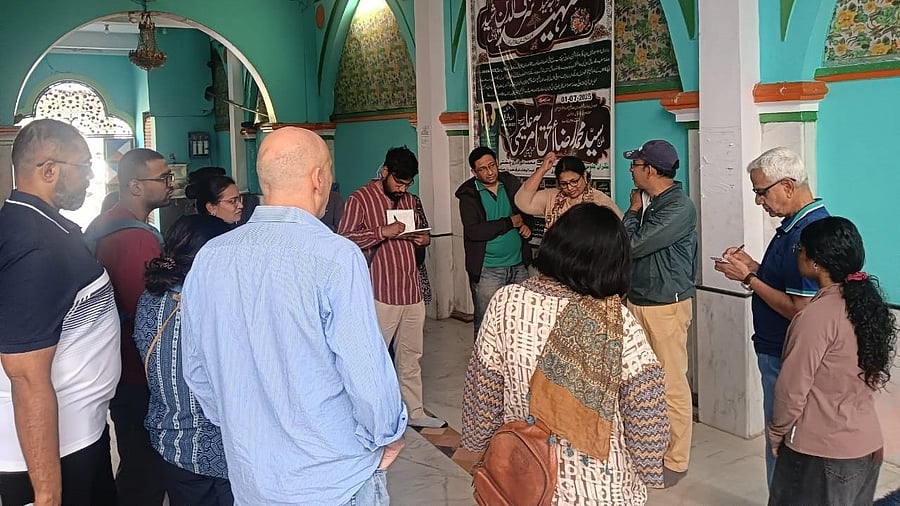
On a 3.5 km walk led by Mansoor Ali of Bengaluru by Foot at Nagarathpet, participants discovered the neighbourhood’s stories of faith and heroism. The group of 15 wove through the dargahs of Khwaja Shah Sharfuddin and brothers Hamid and Muhib Shah, who served in Tipu Sultan’s army. Ali said that Muhib Shah’s dargah is unusual for its open roof. The walk continued to Taramandalpet, where Tipu once made and tested rockets before the area was razed by Lord Cornwallis during the 1791 Siege of Bangalore.
Temple stories
At Gavipuram, the walk explored the history of the neighbourhood, a less-known locality, along with its temples and lakes. The walk was led by Raksha Nagaraj of Prayana Bengaluru.
The walk covered the history of three temples. The Sri Gavi Gangadhareshwara Swamy Temple, after which the locality is named, was built inside a cave in the 16th century and later renovated by Hiriya Kempegowda. The hilltop Hari-Hara Temple and the Bande Mahakali Temple were the other temples the group visited.
Cantonment history
The ‘Once Upon a Sleepy Station’ walk traced the history of the Cantonment area. It was led by Intach-trained Septhar Mukunda and Deepthi Raghuram. Near Bengaluru Cantonment Station, Mukunda spoke about the Bangalore Mail, the city’s first train, which ran from the station to Jolarpettai, Tamil Nadu, on August 1, 1864. The group then moved to the BESCOM C Station, the Friend in Need Society (an old age home), the Kambalposh Dargah, and the Sree Kasi Vishwanatheswara Temple in Sulthangunta.
Colonial past
The Colonial Crawl, organised by Gully Tours, was geared more towards newer Bengalureans, unfamiliar with iconic landmarks scattered across the city centre. Facilitator Rohith Siingh, guided a group of 10 participants through the Edward VII (with inscriptions in English, Kannada, Tamil and Urdu, and not a single letter in Hindi, he pointed out) and Queen Victoria statues (created by the same artist as that of her statues in London) at Cubbon Park before moving on to spots on British era ‘South Parade’ Road, now M G Road. The walk made stops at a British era photo studio, ice cream parlour and shopping complex. It ended at Koshy’s, another of the city’s historic eateries.