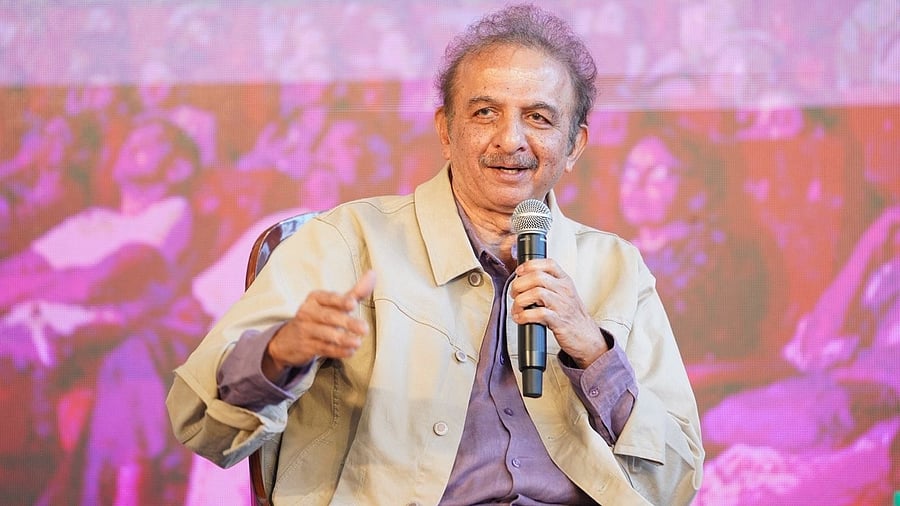
Writer Jayant Kaikini speaks on the last day of the Bengaluru International Film Festival here on Tuesday.
Credit: Special Arrangement
Bengaluru: Kannada writer, poet and lyricist Jayant Kaikini described his interest in cinema as his greatest wealth.
He cited an iconic film dialogue in which Shashi Kapoor says he holds his mother above all material wealth.
Kaikini spoke at a session moderated by writer, director & editor Prashanth Pandit on Day 7 of Bengaluru International Film Festival on Tuesday. The festival concludes Friday. He recalled watching movies at touring talkies (tent cinemas) in his hometown Gokarna.
"I developed interest watching ‘Katari Veera’, ‘Chandavalliya Thota’, ‘Beedi Basavanna’ & ‘Choori Chikkanna',” he said. Talking about ‘dabba cinema’, he spoke fondly about era of cans.
“Back then, movies came as reels in cans. If a movie was bad, and there were no viewers, it remained in can (dabba), that’s where the term ‘dabba film’ comes from,” he said.
One day he saw reels of ‘Katari Veera’ being loaded on top of a bus. “At Gokarna bus stand, I was devastated to see stars like Rajkumar & Udaykumar trapped in dabba and travelling on top of a bus, not even on a seat inside,” he said.
Recalling Shashi Kapoor’s popular dialogue from ‘Deewar', ‘Mere paas maa hai’, he said, “If someone asks me today what I have, I say ‘mere paas cinemaa hai’".
Quoting Javed Akhtar, he said film songs were the background music of Indians’ lives. “We feel sleepy when we listen to Talat Mahmood’s songs because our parents used to sing them to us as lullabies,” he said.
Cinema is best experienced as community activity, he said. He compared those preferring to watch films alone to students who study alone just to come first in class.
In 2006, when he watched ‘Rang de Basanti’ for first time in a theatre, he enjoyed the experience. A few weeks later, when he went a second time with Kannada film director Sunil Kumar Desai, the magic was missing. “It was because the theatre was empty,” he remarked.
Since cinema moved to CDs, DVDs and mobile phones, Kaikini believes, it is stripped of community essence.
Writing songs
"I wrote my first film song, ‘Anisutide’ (Mungaru Male, 2006), a romantic one, when I was 55. Nobody should suffer such a tragedy,” he said, laughing.
Writing film songs is dismissed as frivolous, but it is a challenge to write words to a ready tune, he said.
“As much as 97% of our film songs are about love. What is left to write? That in itself is a challenge. Lines we cannot say to companions, wives or girlfriends, we write for two strangers in film,” he said. Writing for ‘Ponniyin Selvan’ films (2022, 2023) was another challenge.
"In Tamil, love is kadal and in Kannada it is preeti, prema… The lips touch while saying it in Kannada, but in Tamil, they don’t. I asked Mani Ratnam, ‘how do you say love without letting lips touch’,” he said. Uproarious laughter followed.
In literature, vyakta evokes avyakta (the said evokes the unsaid). In music shravya evokes ashravya (the heard evokes unheard). In painting or photography, drishya evokes adrishya (seen evokes unseen). But cinema is a medium with all three elements, he said.
In recent years, film buffs who discovered Kaikini through his songs have started reading his books.
He had a word of advice to fans: “Live intensely. Anything you experience in life becomes part of your subconscious memory and will impact your art and what you do,” he said.