
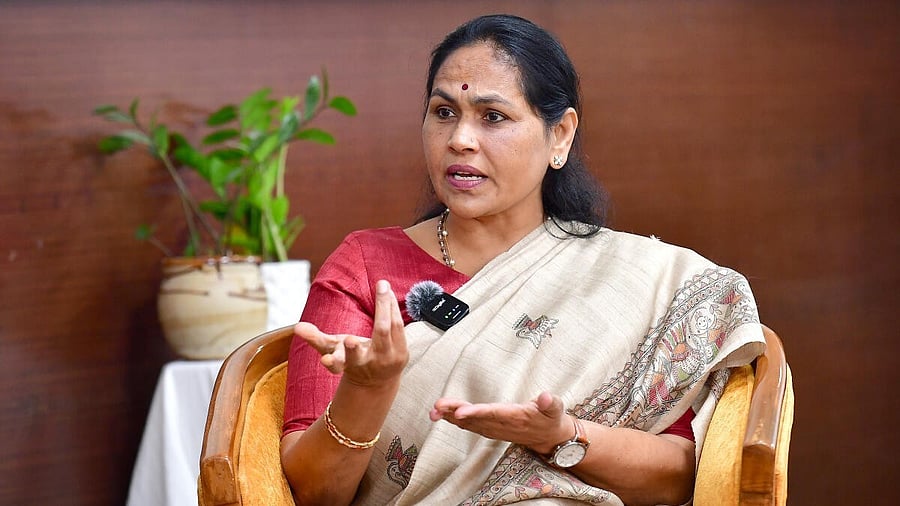
Shobha Karandlaje.
Credit: DH Photo
New Delhi: Union Minister of State for Labour Shobha Karandlaje on Friday urged Karnataka Governor Thaawar Chand Gehlot to withhold assent to the Karnataka Hate Speech and Hate Crimes (Prevention) Bill, 2025, and to reserve the same for the consideration of the President under Article 200 of the Constitution of India, in the ‘larger interest’ of constitutional governance, democratic freedoms, and the rule of law.
In her letter to the Governor, the Minister said, "The Bill, in its present form, establishes a State-controlled mechanism for monitoring, assessing, and penalising speech, rather than narrowly addressing expression that poses a clear and imminent threat to public order."
"The structure of the Bill enables executive authorities to determine the permissibility of expression, thereby transforming the law into a tool capable of suppressing voices critical of the government. Such an approach undermines the constitutional guarantee of democratic dissent and free expression," the letter read.
"The Bill authorizes executive authorities and law-enforcement agencies to assess and act upon speech without adequate judicial oversight. Penal consequences are linked to executive assessment, thereby concentrating investigative and adjudicatory functions within the Executive. Such an arrangement erodes procedural safeguards and is inconsistent with constitutional principles governing the protection of fundamental rights," Shobha, BJP Lok Sabha member from Bengaluru North, said.
She expressed concern that the legislation may be invoked to silence Kannada language activists, women's organisations, representatives of Scheduled Castes and Scheduled Tribes, backward classes, minorities, journalists, student groups, and civil society organisations that raise issues of governance, social justice, or administrative accountability.
"Instead of empowering vulnerable communities, the Bill risks becoming an instrument to deter them from articulating grievances and participating meaningfully in public discourse, thereby defeating the very constitutional promise of equality, dignity, and inclusive democracy," she said in her letter.
She also said that the legislation has attracted widespread opposition from civil society organisations, journalists' associations and legal bodies, who have expressed serious apprehension that it may be used to suppress legitimate criticism and dissent.
"Given that the Bill directly impacts fundamental rights guaranteed under Part III of the Constitution, and in view of the serious constitutional questions it raises, this is a fit case for the exercise of constitutional discretion under Article 200. Reserving the Bill for the consideration of the Hon'ble President would enable a broader constitutional examination of its implications for civil liberties and the federal constitutional balance," she said in her letter.