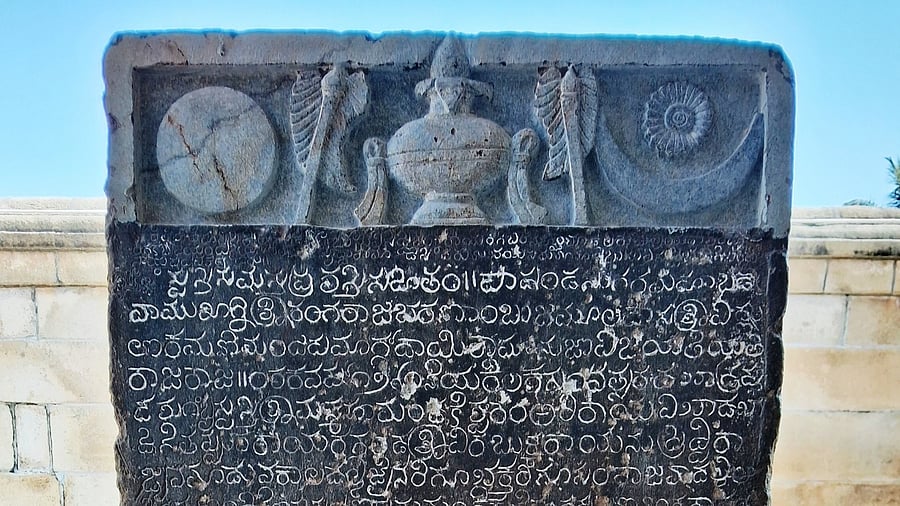
The Bukka Raya inscription dated 1368 at Shravanabelagola.
Credit: Kirti Malhotra
When I visited the Lingayat Math at Kempasagara in Ramanagara district, I was told that most of its priests, at the turn of the 20th century, had shifted to another math on a small hill in Kalya. On my return journey, a signboard in Magadi town reading ‘Kalya Gate’ caught my eye. Acting on impulse, I got down and walked six kilometres to reach Kalya.
The Lingayat Math at Kalya, popularly known as the Jangama Math, stands in an area called ‘Naalku Kallu Mantapa’. Walking through the area overgrown with weeds, I climbed a hillock to reach the Math complex. As I entered, a huge and serene courtyard engulfed me. The pillars, though bearing beautiful carvings, had been heavily plastered. As dusk fell, I decided to explore Kalya in detail another day.
At the village bus stop, a series of posters about Kalya’s history sparked my curiosity. Back home, I turned to online archival materials and soon came across the Archaeological Survey of Mysore (ASM) report for 1892-93. It spoke about Kallehada-pattana mentioned in an interesting ‘Ramanujachari inscription’ at ‘Sravana Belgola’ (now Shravanabelagola). The inscription records how the Jainas (Jains) complained to Bukka-Raya (Bukka Raya I) of Vijayanagar (Vijayanagara) of obstruction from the Vaishnavas and how the king reconciled the disputes. Kallehada-pattana, as per ASM, ‘has now been clearly identified with Kalya near Magadi’. ASM also states that ‘a duplicate of the Ramanujachari inscription has been found’ at Kalya.
The earliest reference of this inscription appears in the accounts of the Jainas collected from a priest of the sect at Mudgeri for Major C Mackenzie, published in the form of a report in 1809 AD.
The complete text of the Shravanabelagola inscription was published in Inscriptions at Sravana Belgola by B Lewis Rice in 1889 AD while the Epigraphia Carnatica (EC Vol 2), 1923 refers to the inscription at Kalya as ‘another version’ of the one at Shravanabelagola. The text of Kalya’s inscription was found in EC Vol 9, 1905. Both inscriptions date to 1368 AD.
Having learnt more about these inscriptions, I again travelled to Kalya to locate the inscription, commonly known as Bukka Raya’s inscription stone. I met Bomma Lingaiah, the present owner of the fields where the stone stands erect. I later learnt that a few years ago, a team from The Mythic Society traced nine unpublished inscriptions at Kalya. Probably then, a neat enclosure was built around this inscription, with an information board explaining its importance. However, the board has now disappeared, and the enclosure lies in ruins.
Returning with a heavy heart, that such an important inscription is again in peril, I decided to see the condition of the ‘original’ inscription at Shravanabelagola. An early morning bus took me to Channarayapatna and then to Belagola. At the Bhandari Basadi, I found the inscription stone safely housed within the inner enclosure, protected from sun and rain.
Conflicts have always been there in the history of humankind, but here was a rare inscription recording an earnest effort to resolve one of them. On continued search, I found a research paper by noted historian Dr Chidananda Murthy, published in 1988. This paper made an interesting observation: the Kalya text is the ‘original one’ and the Belagola text is a ‘modified, softened and enlarged’ one. Regardless, both inscriptions record a pact made by Vira Bukka Raya between the Vaishnavas and the Jainas, by placing the hands of the Jainas on the hands of the Vaishnavas and that ‘the Vaishnava creed would continue to protect the Jaina darsana’. Darsana here refers to religious processions of devotees visiting shrines. The Epigraphia Carnatica, records 'between the Vaishnavas darsana and Jaina darsana, there is no difference’; that ‘if to the Jaina darsana any injury on the part of the bhaktas should arise, it will be protected as if injury to the Vaishnavas had arisen.’
In a world ridden with conflicts today, Bukka Raya’s attempt at pointing to the oneness of all the religions and decreeing that people of one religion must protect the other is worth emulating.