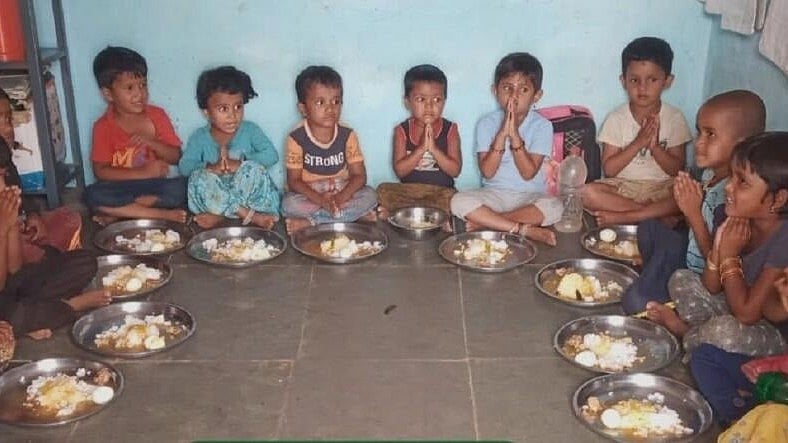
Children having mid-day meals at an anganwadi in Bidar’s Chitguppa taluk.
Credit: DH Photo
The seven districts of Kalyana Karnataka have seen a remarkable decline in severe malnutrition among children over the last four years, with numbers dropping by nearly 80 per cent — from 11,750 in 2022-23 to 2,582 in 2025-26.
Officials attribute the improvement to the supply of highly nutritious foods, including eggs, milk and moringa powder, under various government schemes, along with consistent awareness campaigns targeting parents.
A decade ago, districts like Raichur, Ballari, Koppal and Kalaburagi made headlines for high child malnutrition, driven by acute poverty, child marriage and poor dietary practices. Children of daily wage earners and vulnerable communities were the worst affected. Many were admitted to Nutrition Rehabilitation Centres (NRCs) for continuous medical treatment and nutritional support under the supervision of trained pediatricians.
The Rashtriya Bal Swasthya Karyakram (RBSK), under the National Health Mission, has played a crucial role in this turnaround. The scheme focuses on early identification and treatment of birth defects, deficiencies, diseases, developmental delays and disabilities, including malnutrition and congenital disorders. In Raichur district, the number of severely malnourished children dropped from 5,226 in 2022-23 to 1,066 in 2025-26. Ballari recorded a decrease from 3,807 to 353, while Kalaburagi’s numbers fell from 1,709 to 389.
“The government’s Poshan Abhiyaan, which targets key nutrition parameters for children and women, has significantly helped our efforts to make the district malnutrition-free,” said Naveen Kumar, Deputy Director of Raichur Women and Child Development Department.
He added that awareness campaigns promoting milk powder consumption, daily egg distribution for pregnant women and children in anganwadis, and experimental moringa supplementation over six months last year have all contributed to the improvement. “We also received support from the Azim Premji Foundation and Tata Trust,” he said.
Dr Shankrappa Mailare, Kalaburagi Divisional Joint Director of Health and Family Welfare, said specialised teams of doctors and staff nurses have been deployed under RBSK scheme in each taluk based on population. “They conduct regular inspections at schools and anganwadis, guide workers and parents on nutrition, and ensure severely malnourished children are admitted to NRCs. Five beds are reserved for them in every taluk hospital,” he said.
Health activist Dr Gopal Dabade said malnutrition in North Karnataka has declined significantly over the past decade. “Kwashiorkor, a severe protein-deficiency malnutrition, was common decades ago. Now children’s health has improved,” he said.