
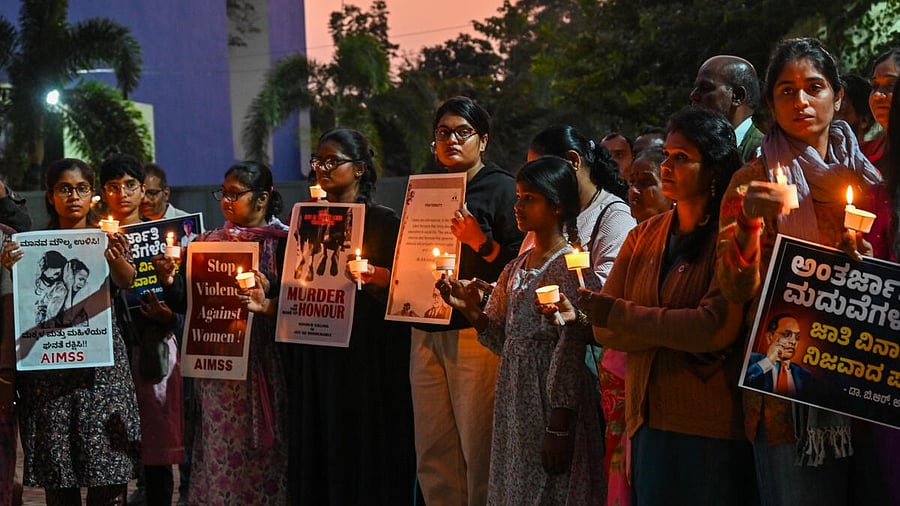
A coalition of organisations gathers to condemn the recent honour killing that took place in Hubballi, followed by a candle‑light vigil at Freedom Park, Bengaluru on Friday, December 26, 2025.
Credit: DH PHOTO/PUSHKAR V
The Karnataka government is in the process of coming up with a comprehensive law aimed at preventing and punishing crimes committed in the name of “honour” and tradition, particularly those targeting inter-caste couples. Titled 'The Karnataka Freedom of Choice in Marriage and Prevention and Prohibition of Crimes in the Name of Honour and Tradition Bill, 2026', the proposed legislation seeks to strongly affirm the right to choose one’s partner while introducing stringent penalties for violence, coercion and intimidation.
Here is a breakdown of what the draft bill proposes:
Why is the Bill being brought now?
The proposed law comes in the aftermath of the murder of Manya Patil in Hubballi, who was allegedly killed by members of her own family for marrying a man from a Scheduled Caste (SC) community. The case once again brought focus to so-called honour killings and caste-based violence in the state.
What is the Bill called?
Apart from its formal name, the proposed law has also been referred to as ‘Eva Nammava Eva Nammava Kanoonu, 2026’, inspired by a well-known Vachana by 12th-century reformer and anti-caste advocate Basavanna. The name is said to have been suggested by Law and Parliamentary Affairs Minister H K Patil.
What rights does the Bill recognise?
Section 3(1) of the Bill explicitly states that all persons have autonomy over their own lives, including:
The right to liberty
Freedom of expression
Freedom to marry a person of their choice
The Bill also allows couples planning an inter-caste marriage to inform the district magistrate or a designated nodal officer about their decision.
While this declaration is optional and “shall not be a pre-condition”, it acts as a safeguard by ensuring that “no action shall be taken by the police or any other authority at the instance of family members, relatives or community members.”
What punishments does the Bill propose for honour-based violence?
Causing “grievous hurt” to a couple, or either of them, in the name of honour will attract a minimum of 10 years of rigorous imprisonment, which may extend to life imprisonment, along with a fine of up to Rs 3 lakh.
In cases of killing in the name of 'honour', the Bill mandates a minimum five-year imprisonment, in addition to punishment under the Bharatiya Nyaya Samhita (BNS).
How does the Bill address sexual relationships and false promises of marriage?
The draft law criminalises sexual intercourse obtained through a false promise of marriage in inter-caste alliances.
"Any person who engages in sexual intercourse with an adult woman by giving assurance or promise of marriage, and subsequently refuses to fulfil such promise upon disclosure or knowledge of the woman’s caste, shall be deemed to have obtained consent by deceitful means or under misconception of fact," the bill states.
This act will be punishable as rape, with rigorous imprisonment of at least five years, extendable to life imprisonment, along with a fine.
The burden of proof lies on the accused to show that:
The promise was made in good faith, or
The refusal was due to unforeseen circumstances unrelated to caste.
However, the Bill makes exceptions for:
Genuine breaches of promise due to circumstances beyond one’s control
Cases where the woman was aware from the beginning that marriage was unlikely on caste grounds, without any assurance to the contrary.
What protection does the Bill offer to couples and victims?
Under the proposed Bill, anyone who chooses to marry a person of their choice, as well as those who become victims under this law, can ask for protection for themselves, their family members and witnesses. This protection is meant to shield them from threats, pressure, harassment or any form of violence.
The Bill clearly states that the police must step in quickly and provide protection within six hours of a request being made. This applies not only when a marriage has already taken place, but also when a couple fears trouble because they are planning to get married. The government is also required to arrange safe shelter for couples who have nowhere else to go.
What institutional mechanisms does the Bill propose?
The Bill also lays down steps to prevent such crimes at the local level. It asks the state government to identify districts, sub-divisions and villages where crimes in the name of honour or tradition have been reported in the last five years. Every district must have a Special Cell to deal specifically with such cases. In addition, the district magistrate can set up an ‘Iva Nammava Vedike’, a local forum made up of officials and other members decided by the government. This forum will help couples get married safely, offer counselling and carry out other related work as laid down in the law.