
Credit: DH Photo
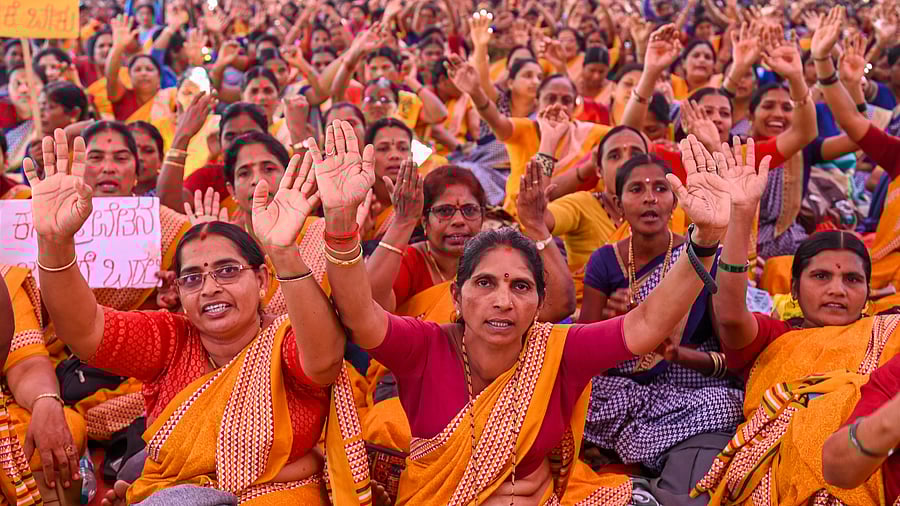
Tears well up in Basamma’s eyes as she recounts her life of service. A resident of Koppal, Basamma has been working for over 20 years as an anganwadi worker, putting in nearly 10 hours a day for a modest honorarium of Rs 12,500 per month.
“I will be retiring in the next couple of years, but there are no post-retirement benefits. The only solace is that we have worked with dedication. Much more could have been achieved had successive governments responded positively to our demands,” she says.
Basamma’s story reflects the plight of thousands of anganwadi workers across Karnataka who work tirelessly to implement child and maternal health programmes.
Pre-nursery classes
Karnataka is among the few states where anganwadi centres have played a crucial role not only in running pre-nursery education centres, but also in combating malnutrition, reducing infant and maternal mortality rates, monitoring the health of undernourished children and providing nutritious food to pregnant and lactating women.
This year marks the golden jubilee of anganwadi centres in the state. Launched in 1975 in Mysuru district, the initiative later expanded across the state. However, despite completing 50 years and overcoming numerous challenges, the system has not evolved to its full potential.
While successive governments have introduced several health schemes to address malnutrition and promote institutional deliveries, issues faced by anganwadi workers have largely been ignored.
According to the women and child welfare department, Karnataka has 69,919 functional anganwadi centres. But due to inadequate funding and prolonged neglect, nearly 33.5% — about 16,000 centres — operate from rented buildings. Another 20% function out of ashraya houses, temple premises and community halls.
District-wise, 465 anganwadi centres in Dharwad operate from rented premises, followed by Belagavi (1,360), Tumakuru (568), Kalaburagi (600), Mysuru (265), Shivamogga (166), Mandya (161) and Hassan (116).
Crammed premises
“Running anganwadi centres from rented buildings poses several challenges. There is severe shortage of space, no separate kitchen and no playgrounds. Often, we are forced to pay rent from our own salaries due to delays in reimbursement by the department,” said Savitri, an anganwadi worker from Koppal.
Another major concern is the rising cost of vegetables and eggs. Workers allege that fluctuating prices force them to pay the difference from their own pockets.
“Eggs currently cost between Rs 7 and Rs 8 each, but the government allocates only Rs 5 per egg. When we raise this issue, officials ask us to manage within sanctioned funds or pay the difference ourselves. At times, we are even instructed to purchase eggs strictly within allotted funds, which means some children go without eggs,” said Arati, an anganwadi worker from Dharwad.
The department has also advised some anganwadi centres to grow vegetables to meet nutritional requirements. However, workers say this is impractical given their workload and lack of time.
Services unregularised
All India United Trade Union Centre (AIUTUC) state president Somashekar Yadgir told DH that the demand to include anganwadi workers and helpers under group ‘C’ and ‘D’ cadres had remained unaddressed for nearly two decades.
“At present, an anganwadi worker receives an honorarium of Rs 12,500, while a helper gets Rs 6,500. Given the rising prices, it is impossible to run the household on such meagre pay,” he said.
He said while anganwadi working hours were earlier from 9 am to 1 pm, they have been extended up to 4 pm over the past three years without additional benefits.
Yadgir pointed out that even after 50 years, the integrated child development services continue to be treated as a scheme rather than a full-fledged department.
Earlier, the union government contributed 90% of the funding, but allocations were reduced after 2014. The state government has not revised the honorarium, he said.
Malnourishment challenge
Social activist and secretary of Jagruti organisation Gopal Dabade said malnutrition continued to be a major public health challenge.
“Every third child under the age of five years suffers from chronic malnutrition. Studies conducted in Belagavi and Koppal using WHO growth standards show 32% of children under five are underweight,” he said.
He said as per the NITI Aayog (Nourishing India: National Nutritional Strategy), five districts in Karnataka - Ballari, Bagalkot, Koppal, Kalaburagi and Yadgir are among 100 poor performing districts with very high levels of stunting.