
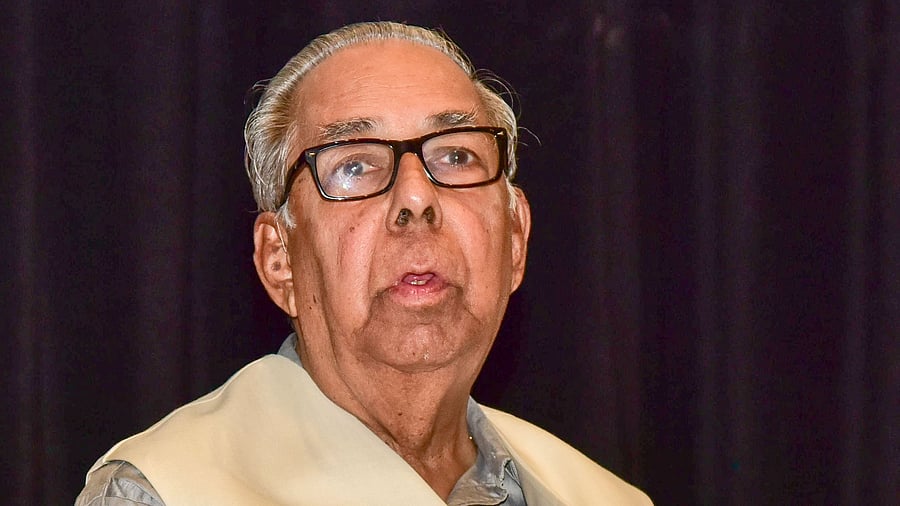
B V Acharya
Credit: DH Photo
The proposed state Hate Speech Bill could be stalled by the Governor by declining assent or referring it to the President if it is repugnant to the existing central laws, former advocate-general B V Acharya said on Saturday.
The senior advocate was addressing a seminar here on ‘Hate Speech Bill and Civil Liberties’ organised by Citizens for Democracy.
“Luckily, the Bill has not yet received the Governor’s assent. People must be made aware of its consequences. Governor (Thaawarchand Gehlot) is constitutionally bound to consider public representations and can decline assent or reserve the Bill for the President’s consideration,” Acharya said, calling freedom of expression and personal liberty the “most cherished fundamental rights.” Any attempt to curtail these rights, he warned, must be resisted.
“If there is repugnancy between a Central and a State law on a subject in the concurrent list, the Central law will prevail unless the state Bill receives the President’s assent,” Acharya said, adding that citizens should actively petition the President to stall the “draconian and unnecessary” law.
Pointing out that existing provisions under the Bharatiya Nyaya Sanhita (BNS) already address hate speech-related offences, Acharya said, “Sec 299 (deliberate and malicious acts meant to outrage religious feelings) and Sec 196 (promoting enmity between groups based on religion and caste), which deal with similar objectives, already exist. The Bill merely changes wording while expanding definitions dangerously.”
Acharya also flagged "vague" definitions of "hate speech," inclusion of even deceased persons and punishing organisations without clarity on liability. He also highlighted the disproportionate punishment prescribed under the proposed law.
“While the Central law prescribes imprisonment up to three years or fine, the state Bill proposes punishment up to seven years with a minimum of one year and fines up to Rs 50,000. This is grossly disproportionate to the alleged offence," he said.
Former advocate general said: “If there is repugnancy between a Central and a State law on a subject in the concurrent list the Central law will prevail unless the state Bill receives the President’s assent.
‘A potential Bhasmasura’ Former police officer Jyothi Prakash Mirji questioned how organisations could be punished for an individual’s speech and warned of an “arrest first investigate later” culture. “Will the government open hate-speech police stations too” he asked calling the Bill a potential “Bhasmasura” that could turn against the government itself.