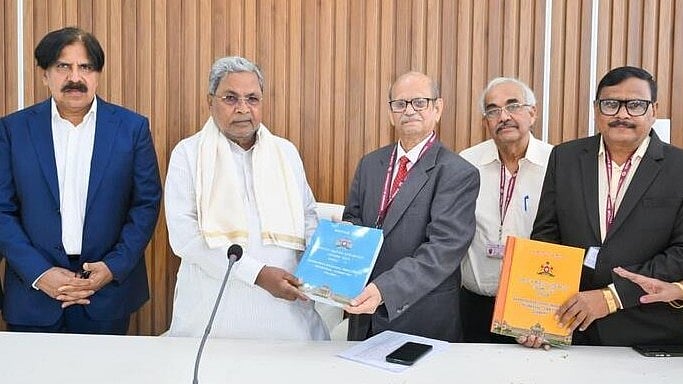
Economist M Govinda Rao submitting his report on regional imbalances to Chief Minister Siddaramaiah.
Credit: CMO
Bengaluru: The latest assessment of backwardness in Karnataka has led to a debate among policy experts amid concerns that developmental deficits have not been adequately met despite the government spending Rs 32,000 crore to fight regional imbalances.
Out of 236 taluks in the State, the Karnataka Regional Imbalances Redressal Committee, headed by economist M Govinda Rao, has categoried 59 as ‘most backward’, 59 as ‘more backward’, 59 as ‘backward’ and the remaining 59 as ‘developed’. This means there is backwardness in 75% of all taluks.
In 2002, the D M Nanjundappa committee, the first high-powered committee for redressal of regional imbalances, had found backwardness in 118 taluks. This included 39 ‘most backward’ taluks, 40 ‘more backward’ and 39 ‘backward’. The remaining 61 were ‘developed’ taluks. Then, Karnataka had 175 taluks, of which 67% had backwardness.
Based on the recommendations of the Nanjundappa committee, the government spent Rs 32,610.24 crore from 2007-08 to 2022-23.
Social entrepreneur Ashwin Mahesh asked the government to make the Rao committee’s report public.
“75% of taluks in the State are backward? The report of the Regional Imbalances Committee is now with the government. 20+ years ago, another such committee made recommendations, but that hasn't changed this much (sic),” Mahesh said. “What is needed is a Regional Imbalances Correction Initiative that implements the various recommendations [and] measures progress publicly.”
Mahesh said he has been working on a District Development Dashboards that Ministers can use. “So far, I've made some headway with this in a few places. Such public engagement with public problems is needed everywhere. The sarkar on its own can do a few things, but that is not enough to overcome such large deficits in development. Concerted action across State, market and society is needed,” he argued.
Retired IAS officer L K Atheeq, a member of the Rao committee, said it is “provocative” to say that 75% of taluks in the State are backward.
“The two committees (Nanjundappa and Rao) followed different conceptual frameworks and methodologies and therefore the results are not comparable,” Atheeq said.
“Development is a continuous process and all taluks have progressed. The Rao committee has made this very clear in its report,” Atheeq said. “In a continuum of most backward-to-developed, you can put a line wherever you want depending on how much targeting you want to do. It is an arbitrary cut-off line you choose purposely,” he said.
The Rao committee has divided all taluks into four quartiles of which the bottom three are ‘most backward’, ‘more backward’ and ‘backward’, Atheeq explained.
“This was done consciously, not because 75% of Karnataka’s taluks are backward, but because we need to address borderline cases and in a sliding scale from backwardness to development, in relative terms, most taluks need attention: some more than the others,” Atheeq said.
“It is not correct to say the percentage of backward taluks has increased. It should be said that on a sliding scale, 25% taluks need most attention, 25% need attention but at a lower scale than the first 25% and so on,” Atheeq said.