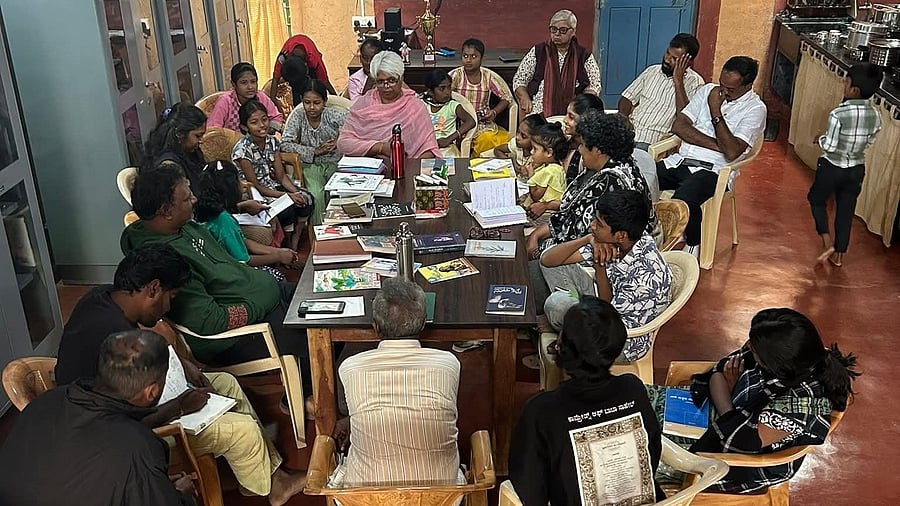
Enthusiasts participate in a playwriting workshop hosted at Ajji’s Learning Centre at Jyothipalya in Magadi taluk of Ramanagara district.
Credit: Akshay Gowtham
Why do we tell a story?
“To make people sleep”; “To trick people.”
These were among the responses offered by children at a playwriting workshop held at Ajji’s Learning Centre (ALC), a non-profit educational trust, tucked into the quiet hamlet of Jyothipalya in Magadi taluk of Ramanagara district, a little over an hour’s bus ride from Bengaluru.
These responses nudged the organisers to the fundamentals of storytelling.
“How can our surroundings, the stories of our land, our people and folklore, passed orally through generations, give birth to new, empowering narratives? That was the premise of our workshop,” said Akshay Gowtham, theatre artiste and coordinator of the 10-day workshop Srishti Mattu Samudayada Kathana.
Conceived as a response to childhoods shaped by reel culture, the workshop, held recently, sought to draw instead from folk songs, folktales and lived experiences rooted in regional language and culture.
Akshay and playwright Kotiganahalli Ramaiah designed the workshop to nurture playwriting, dealing with the subject of adolescence. It aimed to train aspiring writers of children’s plays and to develop their scripts in collaboration with contemporary theatre directors for stage production. What set it apart was their willingness to experiment and not rely on conventional classics.
Over ten days, participants from mixed age groups gathered at the earthy space of ALC, fondly called Ajji Mane by children, set against granite hills and rocky outcrops of Deccan Plateau, some now scarred by mining.
Revolving around folktales driven from local knowledge systems, and objects in the surroundings, like leaves, rocks and flowers, the resource persons conducted sessions on various theatre techniques through games and activities.
“We shared 55 folktales in ten days,” said Akshay. The outcome: participants are now drafting plays inspired by these folktales, which will then be discussed with contemporary theatre directors. Selected plays are slated for performance at ALC in April.
“The themes are mostly deeply rooted in the culture of the land,” Akshay said, adding that one participant is writing the story of a rock, shaping it into a play.
Interestingly, the group of participants was eclectic — a mother and her two adolescent children, a teacher, a therapist and others.
“When we put out the poster, we expected like-minded adults interested in writing folklore-inspired plays for adolescents. Interestingly, children signed up too, making the workshop democratic,” said Kotiganahalli Ramaiah. “The presence of children turned out to be the most challenging and the most rewarding part of the workshop.”
Lakshman K P, who conducted sessions on theatrical narration, said, “We did not refer to classics or written plays. We spoke about everyday acts like bargaining with a vegetable seller. Drawing from lived experience means recognising the experiences of both performer and audience. That’s when a story becomes ours.”
The other resource persons included Gangamma, an 86-year-old folk singer and folklorist; Dayananda, an author, theatre personality Satish Tiptur; poet and playwright T H Lavakumar, folk singer and folklorist Sobane Ramaiah and theatre practitioner Chandrashekhar Ninasam.
Ajji Mane
Ajji’s Learning Centre was founded by educator Sabiha Hashmi in 2022 with a focus on education of the villagers, especially girls, through workshops and vocational skills.
Affectionately called Ajji by local children, Sabiha passed away just a month after the formal inception of ALC. Today, ALC continues her vision. Children, girls and women from over 40 villages in Magadi taluk visit the space to learn tailoring, computers and spoken English. The group also engages in birding and participates in workshops on art and theatre.
Human rights activist Shabnam Hashmi, Sabiha’s sister, who leads the initiative now, said ALC has evolved into a hub that refuses to let Sabiha’s dream fade. “In a world where rural narratives are often appropriated or caricatured by urban filmmakers and writers, ALC opened its doors for local voices to write their own histories, their tragedies and their comedies,” she said.
From story to stage
Kotiganahalli Ramaiah, who has worked with children for over two decades, said, “In recent days, there is a rise in crime among adolescents. Psychological challenges that once appeared in late adolescence are now surfacing in children below nine.”
According to him, transferring folk wisdom to younger generations is the need of the hour.
Participants explore story ideas in a natural setting near the centre.
Credit: Akshay Gowtham
“Social media is increasingly drifting the youth away from their roots,” he said. “But do we have resources in our own languages powerful enough to reach a generation raised on 30-second reels?”
Bringing children closer to their lived realities, he believes, is the only way to anchor them — and perhaps rescue them — from an obscure future.