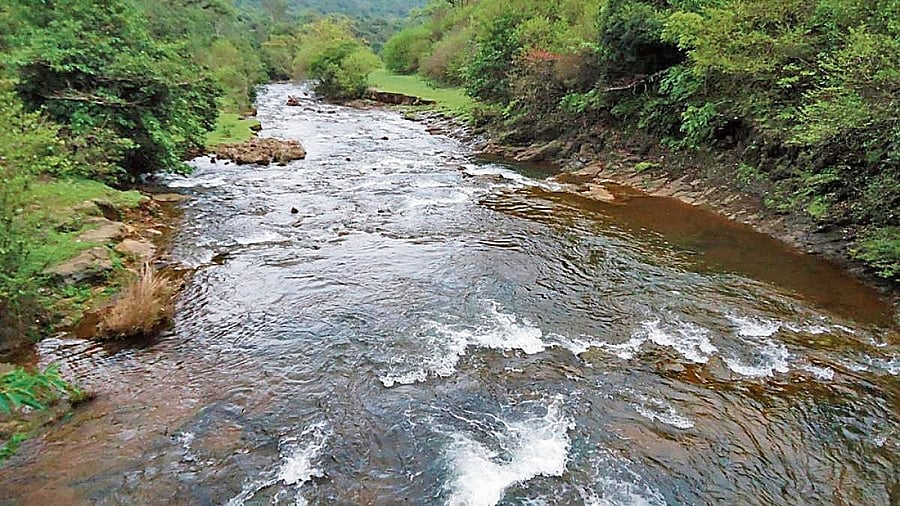
The state government has sought 70 acres of forest in three villages of Khanapur taluk in Belagavi district, for the project to lift 2.18 tmcft water from Mahadayi, to supply water to twin cities of Hubballi-Dharwad and other places.
Credit: DH File Photo
Bengaluru: The state government’s efforts to lift 2.18 tmcft water from Mahadayi to supply water to Hubballi-Dharwad twin cities and other places, has once again failed to convince the environment authorities, who questioned the lack of details, regarding the rehabilitation of 161 families within the protected area.
The government has sought 70 acres of forest in three villages of Khanapur taluk in Belagavi district.
Much of the land will be utilised for the construction of a diversion dam, jack well and pump house, a substation, pipe and power lines. The water will be pumped to Malaprabha to meet demands in the twin cities, Kundagol town and other enroute villages.
Over the last one year, the proposal has been considered twice by the Regional Empowered Committee of the Ministry of Environment, Forests and Climate Change (MoEF&CC). Previously, the government was asked to provide a wildlife mitigation plan as the forest being diverted hosts tiger, leopard and other animals.
Over the last four months, farmers had staged protests pressing for speedy approval of the proposal.
The committee noted that in December 2025, about 400 farmers had gathered in front of Kendriya Sadan in Bengaluru to question the delay in clearing the project.
Biodiversity and rehabilitation
The committee, which met recently, noted that the forest sought by the government was just 29 metres from the boundary of the eco-sensitive zone of the Bhimgad Wildlife Sanctuary.
“The area is fragile in nature from the biodiversity point of view,” it said, questioning the chief wildlife warden’s conclusion that the project will have minimal impact on biodiversity, including wildlife.
Further, the committee sought details of the plans to rehabilitate 161 families from the sanctuary and asked whether the plan was in consonance with the Forest Rights Act.
It noted that this rehabilitation was a key component of the biodiversity and wildlife conservation plan vetted by the chief wildlife warden.
“Neither any detailed relocation plan nor documents regarding willingness of the villagers to relocate was submitted by the state government,” it said, noting that the proposal was “incomplete”.
Further, the state government was also asked to submit the status of all the cases against the project pending before the Supreme Court.