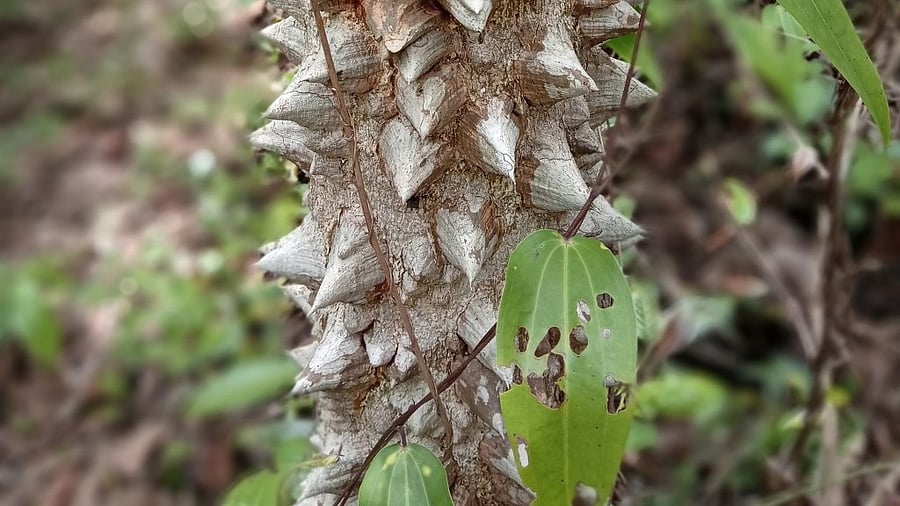
While exploring Mirjan Fort, the Aghanashini river, and hillocks and forests near Uttara Kannada’s Kumta during a school trip, my students came across an unusually shaped tree.
Towering into the sky, its trunk and branches were covered with thick, sharp thorns. Beneath it lay small, dried black fruits giving off a distinctive, heady aroma. Drawn by the smell, some children felt like tasting it. However, they wondered whether the fruit was edible. Their fears eased when Rami Gouda, an 80-year-old man from the Halakki community accompanying us, said, “Don’t worry. This isn’t poisonous. It is jummana kayi which offers a peculiar tingling sensation, particularly on tongues. We use it in fish curry.” The encounter sparked curiosity about this intriguing forest produce in me.
Found mainly in Karnataka’s coastal belt, jummana kayi is botanically known as Zanthoxylum rhetsa. Its common name in English is Indian prickly ash. The thorny, medium-leaved tree grows widely in the forests of Karwar, Ankola, Kumta, Sirsi, Siddapur and surrounding regions including Goa. Locally it has several names: gavanti mara in local Kannada, teppal or terpal in Konkani and kavatti kayi or petala in Tulu.
The name jummana kayi is traced either to the tree’s heavily thorned bark or to the tingling sensation the fruit produces. Endemic to the Western Ghats, the tree grows 30–35 metres tall. After the monsoon, it bears white flowers and by November–December, fruits appear in grape-like clusters.
Harvesting is difficult as the tree cannot be climbed directly. Collectors instead climb neighbouring trees and use bamboo sticks fitted with hooks to gather the fruits into large cloth bags. Once harvested, the seeds are extracted and the fruits are sun-dried, releasing a stronger aroma. When properly stored, the fruit can last for a year.
Halakki women gather the fruit and sell it in Gokarna, Ankola and Kumta markets, where locals and tourists eagerly buy it. “Earlier, a cluster was sold for Rs 5–10. Now it costs Rs 50–60,” says a woman trader. “There are fewer trees and fewer people willing to harvest them but it gives us a livelihood,” she adds.
A prized ingredient
Jummana Kayi is a key ingredient in coastal seafood. The woody pericarp of the fruit is used as a spice, especially in curries made with Indian mackerel or sardines. It enhances flavour while easing digestion and countering the heaviness caused by fish consumption. The spice is closely related in taste to Sichuan pepper (Zanthoxylum piperitum), widely used in Chinese and Thai cuisines. It is also used in vegetarian dishes — with ladies’ finger, potato and coconut-based preparations. “In Konkani households, we prepare teppala ambat, a curry using the spice. The curry is eaten with rice, dosas and kotte kadubu (steamed dumplings),” says Padma Pai of Kumta. Ayurvedic medicine uses jummana kayi extensively for its analgesic properties, including in pain-relief sprays.
Yakshagana ornament
The thick bark once had a role in Yakshagana costume-making. “Earlier, we used the bark to make crowns, and shoulder and chest ornaments,” recalls veteran Yakshagana artiste Vidyadhara Rao Jalavalli.
“The hardness of the bark made the ornaments durable. But as the tree has become rare and traditional arisans have disappeared, mango or kadamba trees are now used alongside plastic or fibre ornaments,” says Yakshagana artiste Kondadakuli Ramachandra Hegde. Elderly residents recall other uses. “In the past, the thorns were carved into seals, and sticks from the tree were used like batons,” says 90-year-old Hanumantha Gouda from Ankola.
A toy
Raw jummana kayi is also used as a toy. It is used as pellets triggered by a traditional wooden pipe-like toy, producing a sharp “thad” sound that delights children. The toy is commonly sold during the annual Vitla Pindi festival (Mosaru Kudike) in Udupi.
Once common across forests and hillocks, jummana kayi is slowly vanishing. Hard-to-harvest trees are being lopped for branches, while deforestation and expanding human settlements have shrunk their habitat.
However, the forest department is cultivating this species in its nurseries in Karwar and Ankola. Protecting the tree is important — not just to preserve its distinctive flavour, but also to ensure its survival in the local ecosystem.
(Translated from Kannada by Divyashri Mudakavi)