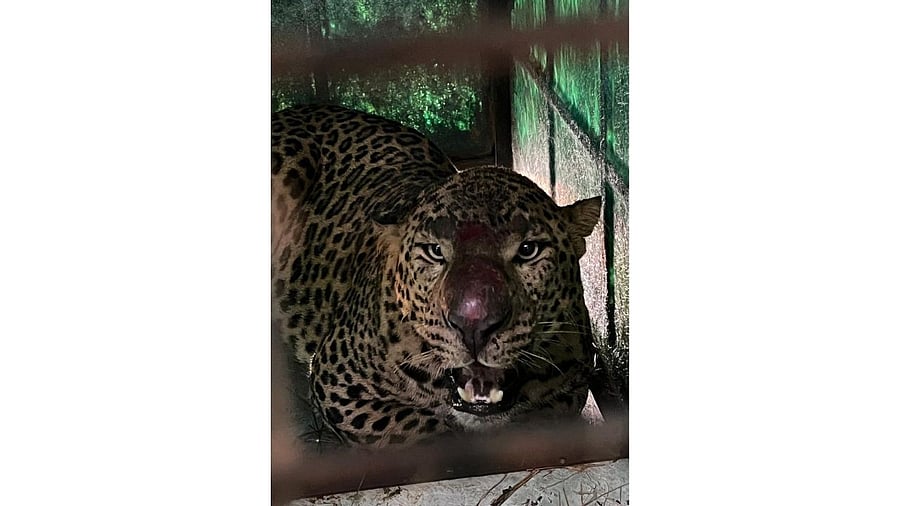
Injured Leopard, rescued at Budahalli village of T Narsipur taluk of Mysuru district on Thursday.
Credit: DH Photo
Mysuru: With an increase in the number of human-animal conflicts and also the animals rescued in the Mysuru region and the death of six tiger cubs at Chamundi Wild Animals Rescue and Rehabilitation Centre of Sri Chamarajendra Zoological Gardens (Mysuru Zoo) at Koorgalli in Mysuru, the need for strengthening wildlife veterinary care infrastructure has gained momentum again.
The officials, including Conservator S S Ravi Shankar, DCF I B Prabhu Gowda, veterinarians and experts feel that the proposed Leopard Rescue and Rehabilitation Centre (LRC) in Mysuru, can also be used as a tiger rescue centre, to manage the tigers rescued from Bandipur, Nagarahole, and BRT Tiger Reserves, and also from Kodagu, Mysuru and Mandya districts. Wildlife expert Sanjay Gubbi stressed on the need for greater investment in both infrastructure and human resources for wildlife care.
Among the 24 tigers and six cubs rescued in Bandipur, Nagarahole, BRT Tiger Reserves, and Hunsur wildlife division from October 15, followed by four tiger attacks, leading to three deaths and one injury, most were shifted from Chamundi Wildlife Rescue and Rehabilitation Centre in Mysuru to Bannerghatta Rescue Centre, which is 150 km away.
The Koorgalli rescue centre has four blocks, with a capacity to hold four each. One quarantine block can house three animals. Though they are expanding, they can accommodate another eight animals. Currently, the Koorgalli rescue centre is full. Among the rescued tigers, six cubs died at Koorgalli centre, while four cubs are shifted to Bannerghatta centre, only two adults are housed in Koorgalli. Even at Bannerghatta centre, there is only one permanent veterinarian, and two on temporary basis. Its holding capacity is 70 to 80, which is full.
Though there is one veterinarian each at NTR, BTR, Madikeri and Mysuru wildlife divisions, there are no hospitals or holding rooms or laboratories for blood test, diagnostic facility for ultrasonography, pregnancy checkup or X-ray. The rescued tigers are often housed in guest rooms. Now, all rescued animals are rushed to Koorgalli rescue centre, which has only one full-time and another contract basis veterinarian, to manage animals at both Zoo and rescue centre.
If there are hospitals at tiger reserves or rescue centre of the Forest department in Mysuru, it would be easy for treatment and soft release of animals to the wild. The officials send samples for testing to a small-scale forensic science lab in Mysuru or full-fledged one at Madivala in Bengaluru and for DNA analysis to CCBM (Centre for Cellular and Molecular Biology) in Hyderabad. There are no wildlife veterinarians in BTR or MM Hill or Bhadra or Kali. All wildlife veterinarians are on deputation from the Animal Husbandry department.
Prabhash Chandra Ray, Principal Chief Conservator of Forests (PCCF) and Chief Wildlife Warden of Karnataka, said the proposal for a full-fledged advanced wildlife rescue and rehabilitation centre in Mysuru is under consideration.
The Conservator of Mysuru Circle has sent proposal to the State government on November 6, 2024, to establish a LRC on 92 acres of land at Yelawala Residency sandalwood plantation, in Mysuru taluk.
In the proposed LRC, there will be an integrated rescue vehicle-cum-ambulance, forensic facility, diagnosis facility, holding facility, treatment and transit centre, quarantine centre, post-mortem room with deep freeze facility and an incinerator.
DCF Prabhu Gowda felt that the students of the Institute of Veterinary Wildlife Research can be integrated with the rescue centre, for manpower and to facilitate research.
Box:
In 2024-25, there were 46 cases of human-animal conflicts (36 elephant attacks, two tiger attacks, and one leopard attack) and seven of them were in Chamarajanagar, eight - Kodagu, seven - Hassan and two - Mysuru district. Among 31 cases of Human-animal conflicts reported this year in Karnataka state, five were in Chamarajanagar, seven in Kodagu, three in Hassan and five in Mysuru district and 11 in other parts of the state - from April 1 to November 7.