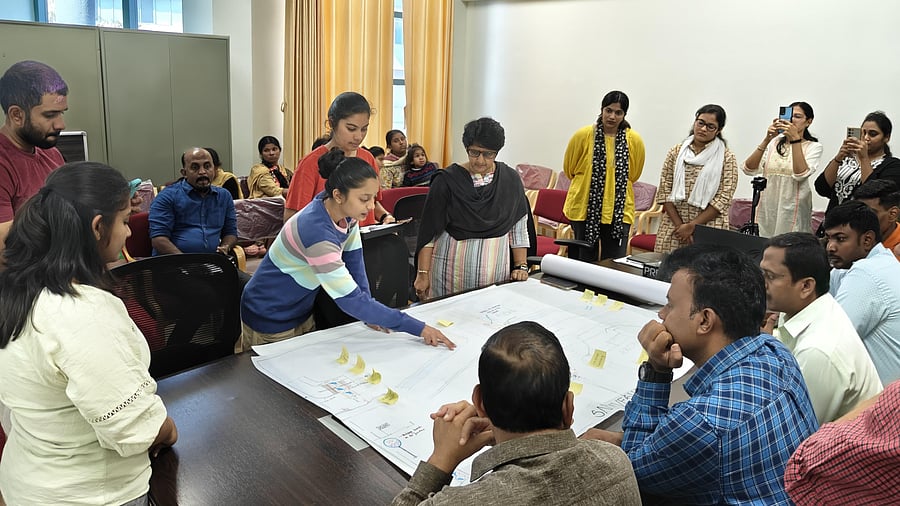
Mysore School of Architecture students and H S Champa brief on the map of the Inclusive Street Re-design during the workshop on AIISH Campus, in Mysuru, on Wednesday. DH PHOTO
Mysuru: In an effort to put people back at the centre of urban planning, the Mysore School of Architecture (MSA), in collaboration with Greenpeace India, organised ‘Samavesha’— a co-creation meet to redesign the busy Bogadi Road junction into a safer, more inclusive public space.
MSA students presented mapping studies and design proposals to improve accessibility for people with disabilities, as well as students and senior citizens, at the Centre of Excellence on AIISH campus, in Mysuru, on Wednesday, during a workshop.
People first
Setting the tone for the discussion, Deepak from Greenpeace India noted that cities are increasingly being designed for vehicles, rather than for people. “We have forgotten what people mean to the city. We somehow design cities for cars and infrastructure, neglecting the people,” he said.
Nightmare
The stretch connecting AIISH, Regional Institute of Education (RIE) and JSS Polytechnic has become unsafe for pedestrians. MSA students flagged several ground-level problems, including damaged footpaths, trees and utility poles blocking walkways, open drains, manholes and the absence of safe pedestrian crossings.
“The footpath does not follow the Persons with Disabilities Act. Wheelchair users from our college are forced to use the road amid traffic because the footpath is inaccessible,” said Manjunath Rao from JSS Polytechnic for the Differently Abled.
Design for everyone
The proposals focused on universal accessibility. Their suggestions include tactile paving for the visually impaired, raised pedestrian crossings to calm traffic and aid wheelchair users, relocating utility poles to free up walking space and using bright colour-coded paths to clearly mark pedestrian zones.
The ideas draw inspiration from tactical urbanism projects in cities like Coimbatore, Tokyo and London.
Testing idea
Director and Dean of MSA H S Champa proposed a ‘tactical urbanism’ approach — trying out temporary, low-cost changes before pushing for permanent ones.
“We plan a live test next Wednesday (January 28) during peak hours. We will show how the space can be used differently,” she said.
Voices
The meeting highlighted the need to protect livelihoods. Selogi from Greenpeace noted that street vendors are part of the urban ecosystem. “We realised that vendors, like the one selling fruit salad near the junction, provide essential services. The design should include them, not push them out,” she said.
Public health expert Sunitha Chandrashekhar suggested sensitising motorists to the needs of vulnerable users. “Constant honking agitates children with special needs,” she said.