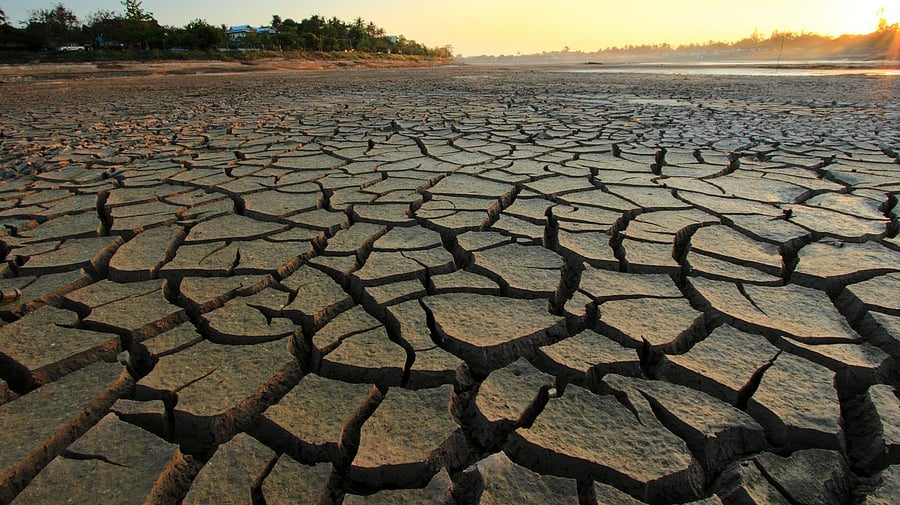
Image of barren land for rperesentational purposes.
Credit: iStock Photo
Hubballi: The Minor Irrigation Department in Athani has proposed an experimental project to improve the groundwater table by “injecting” water from seasonal streams and nalas into aquifers by drilling at least 1,000 perforated borewells across the taluk.
Experts say Managed Aquifer Recharge (MAR) is a tested technology that replenishes groundwater by injecting stormwater, treated wastewater or surface water into aquifers for later use. However, they also warned that unless the project is implemented scientifically, it would be rendered useless if silt gets accumulated.
The department plans to seek a budgetary allocation of Rs 25 crore to drill nearly 1,000 borewells, spaced 500 metres apart, along 10–12 nalas in Belagavi district’s Athani taluk.
Praveen Patil, assistant executive engineer, Minor Irrigation Department, Athani, said farmers in the region are drilling borewells deeper than 800 ft to access groundwater. “Overexploitation has severely impacted groundwater levels,” he said, adding that the department has conducted geological studies in the area for the past 10 years and has prepared a plan to implement the project.
As a precursor to the project, the department carried out a pilot study on the banks of the Agrani river, which flows for nearly 45 km in the taluk.
“We drilled two borewells on the riverbank and allowed floodwater to naturally flow into the tubes to recharge the aquifer,” Patil said, adding that the impact of recharging was observed up to 2 km from the borewells.
Unlike rainwater harvesting or soak pits, which allow infiltration at a slow pace, MAR enables groundwater recharge at a much faster rate and in larger quantities.
Water expert Veena Srinivasan said the success of MAR depends on several factors, including the availability of excess water and effective prevention of silt accumulation. “The most sustainable way to improve groundwater levels is by adopting cropping patterns that retain soil moisture and allow rainwater to infiltrate naturally and recharge aquifers,” she said.
Water conservation expert S Vishwanath said MAR is a scientifically proven method to improve groundwater tables. “The method does not adversely affect the environment as it relies on monsoon flows and not summer water,” he said.
However, he cautioned that implementation is complex and requires a thorough understanding of regional geology, aquifer characteristics, rainfall patterns and availability of surplus water. He said the biggest challenge is preventing silt and impurities from entering injection borewells, as clogging could defeat the purpose of the project.