
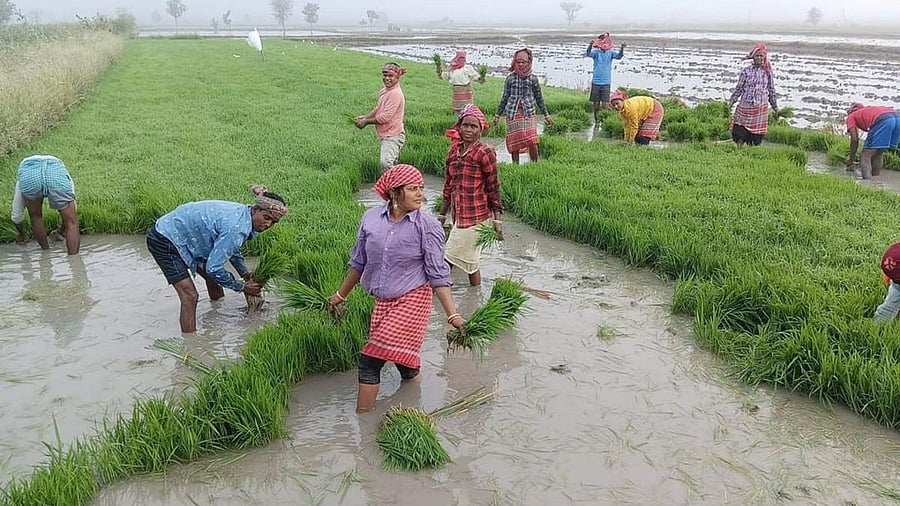
Labourers transplanting paddy crop in Surpur taluk in Yadgir district.
Credit: DH File Photo
Kalaburagi: Hoarding of paddy by big farmers and a steep rise in its price have dealt a blow to rice mills, which are forced to shut down owing to a lack of raw material.
Farmers have stocked paddy after harvesting, anticipating better prices as the Tungabhadra Irrigation Consultative Committee has stopped releasing water for the second crop from the Tungabhadra dam following work to replace its 32 crest gates. Hence, farmers have not grown rabi paddy.
Paddy is grown on around 6 lakh acres of agricultural land in both right and left Tungabhadra canals of Raichur, Ballari, Koppal and Vijayanagar districts, which are known as the ‘rice bowl of Karnataka’.
Paddy yield has also reduced due to floods and heavy rain last year, apart from diseases and pests.
Big farmers tend to hoard crops, as most of them have built warehouses by availing NABARD subsidy over the last few years under the central government scheme. Attributing the price rise to this tendency, farmer leader Chamarasa Malipatil said big farmers are also hoarding paddy of other farmers on a rental basis, he added.
Rice mill owners claimed that around 18 lakh tonnes of paddy are produced in one season, generating a turnover of more than Rs 3,000 crore in four districts. They claimed that hoarding of half the crop grown in the region by farmers has led to a steep rise in the price of Sona Masoori paddy from Rs 1,500 per bag weighing 75kg in November to Rs 1,900 per bag at present.
The price of high-quality RNR variety paddy has also jumped from Rs 1,800 to Rs 2,300 per bag during the last three months.
Therefore, rice mill owners claimed that they are left with no choice but to suspend processing of paddy. They also claimed that retail merchants will not buy the rice at increased rates till their available stock is exhausted. Therefore, the rise in the paddy rate will have to be borne by the rice millers.
“The arrival of paddy in the market has reduced considerably due to hoarding by big farmers. Therefore, we are waiting for paddy from Telangana, where harvesting of the second crop will begin in March. Paddy is being grown on 60% of the agricultural land in neighbouring Telangana as it has witnessed tremendous growth in irrigation during the last decade after the formation of a separate state,” said Rice Mill Owners Association secretary Gururaj Shetty, who owns two mills in Karatagi.
Rice millers claimed that it will take at least one month for retail prices of rice to rise after merchants resort to fresh purchases once their old stock is exhausted.
They also said farmers have resorted to cultivation of hybrid variety paddy by using high levels of fertilisers that will yield crops in a short duration of 3-4 months.
“There has been a qualitative and quantitative deterioration in paddy production. Due to this, we are finding it difficult to survive as we are not getting a good price for rice in the retail market,” said rice miller Sharanappa.