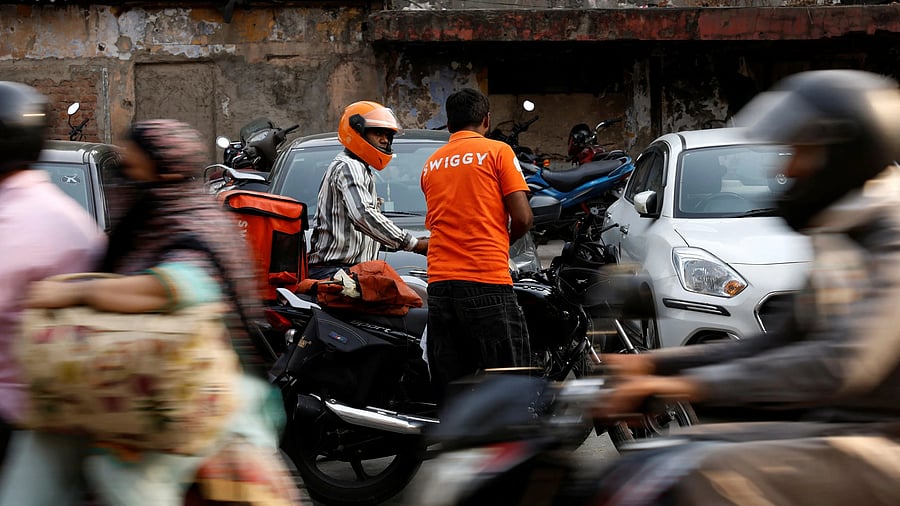
A representative image of gig workers.
Credit: Reuters Photo
Contemporary labour policy interventions, including the new labour codes, irrespective of their merits, reaffirm the foundational tenets of modern labour economics that organisations and labour occupy distinct institutional locations with clearly defined roles, rights and responsibilities towards one another. However, when applied to gig workers, this framework reveals a fundamental misfit. Repeated calls to treat gig workers with dignity directly challenge the prevailing economic understanding of the gig economy in the country. Applying conventional economic frameworks that underpin existing labour policy to gig work is, in itself, poor economics.
The strike by gig workers in December is a manifestation of this mismatch. While the labour codes’ formal recognition of gig and platform workers, along with the mandate for limited social security provisions, represents a belated yet welcome step, it remains insufficient.
Further, some industry and media reports following the New Year strike suggest that the protests had limited operational impact, as platforms relied on incentives and assurances to keep workers logged in. This, in turn, raises a deeper question: can wages or incentives truly function as a market-clearing mechanism at a time when the safety and security of labourers are fundamentally at stake?
The standard economic logic guiding labour policymaking cannot be seamlessly applied to gig work, and attempts to do so have already produced visible and disruptive consequences.
We deliberately set aside questions of implementation and detailed policy critique, which deserve independent and focused attention.
In a labour-surplus economy like India, the much-vaunted flexibility of gig work operates asymmetrically: while workers formally retain the option to log in or out, employers effectively gain the ability to bypass the costs and responsibilities associated with regular employment.
The conventional employer–employee–contract framework does not adequately capture the dynamics of gig work.