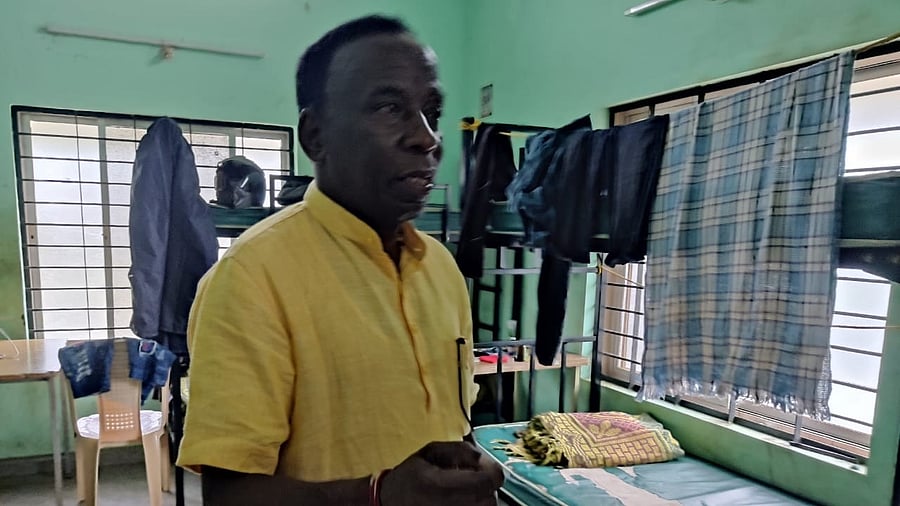
MLC Shantaram Budna Siddi
Credit: X/@ShantaramSiddi
Mangaluru: The Parishishta Pangadagala Olameesalathi Horata Samithi (Scheduled Tribes Internal Reservation Action Committee) has demanded internal reservation for Scheduled Tribes on the lines of the Scheduled Castes quota bill passed by the State Legislature.
“We urge the Karnataka government to immediately initiate the process of implementing internal reservation within Scheduled Tribes. The Supreme Court judgment delivered on August 1, 2024, clearly stated that State governments have the authority to classify reservations within Scheduled Castes and Scheduled Tribes,” said MLC Shantaram Budna Siddi while addressing media person after a consultation meeting with members of various tribal communities in Mangaluru on Sunday.
He urged the government to announce internal reservation for Scheduled Tribes by collecting accurate and reliable data, conducting a comprehensive study on relative backwardness, and ensuring that unequal groups are not treated as equals.
Based on these principles, he demanded that the Karnataka government immediately constitute an independent commission to conduct a detailed study and submit recommendations for sub-classification within Scheduled Tribes.
The MLC said the committee is holding meetings with representatives of Scheduled Tribes in all districts to gather the opinions of community leaders and decide on the future course of action. He recalled that in 2022, the BJP government led by Basavaraj Bommai increased SC and ST reservation in proportion to population.
Following the Supreme Court verdict, the Congress government under Chief Minister Siddaramaiah announced internal reservation within Scheduled Castes based on the recommendations of the Justice Nagamohan Das Commission.
Scheduled Tribes in India are highly diverse and are spread across the country, from the northeastern states to Kerala, largely inhabiting hilly and forest regions. States such as Chhattisgarh (30.6 per cent), Jharkhand (26.2 per cent), Odisha (22.8 per cent), and Madhya Pradesh (21.1 per cent) are recognised for their high tribal population density.
Karnataka Rajya Marati Okkuta president Sundar Naik said Karnataka has 50 Scheduled Tribe communities. According to the 2011 Census, their combined population stands at 42.48 lakh. Of this, the Valmiki community alone accounts for 32.96 lakh, while the remaining 49 tribes together number only 9.52 lakh.
Several tribes such as Adiyan, Bavcha, Dungri Garasia, Chenchu, Halapatti, Goudlu, Kaniyan, Malekudiya, Maleru, and Paniyan have populations of less than 10,000, while some have only a few hundred members.
For many of these communities, government employment remains a distant dream. Communities such as Koraga and Jenu Kuruba are recognised as Particularly Vulnerable Tribal Groups (PVTGs) due to their extreme marginalisation.
Tribes such as Yarava, Soliga, Siddi, Medara, Marathi Naik, Hasala, and Harinashikari have relatively higher populations but still remain below 50,000, he said.
In this context, the comparatively dominant Valmiki community within the Scheduled Tribes must play a protective and inclusive role towards smaller and more marginalised tribes.
Sub-classification within ST reservation would ensure rightful representation and access for smaller and extremely backward communities, he added.