
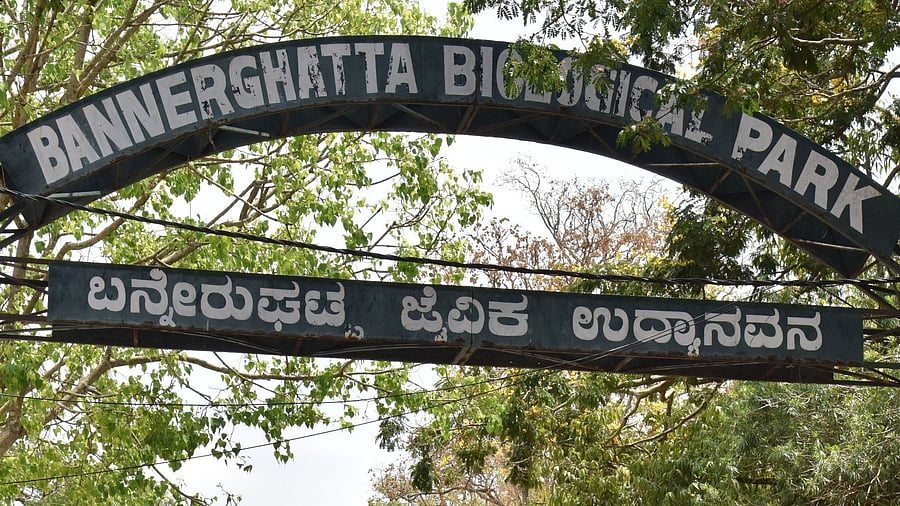
The Bannerghatta National Park.
Credit: DH Photo
Bengaluru: The shrinking of Bannerghatta National Park’s (BNP) eco sensitive zone (ESZ) fuelled a rapid land use change in the sensitive area which is reflected in steady rise in the number of wildlife conflicts over the years.
The central empowered committee (CEC), which placed its report before the Supreme Court on January 5, has highlighted problems that have cropped up after the ESZ was reduced from the range of 100 metre-4.5 km (as proposed in the draft notification) to 100 metre-1 km. The committee noted that the reduction of the ESZ directly affected three elephant corridors.
Even before the reduction of ESZ, the agricultural lands around BNP were changing quickly.
An assessment of the 260 sq km core area and its 5 km buffer by researchers from Indian Institute of Science (IISc) showed that the vegetation cover fell from 85.78% in 1973 to 66.37% in 2015.
This period had seen agriculture and horticulture activities along with mining and built-up areas.
Since the publication of the final notification in March 2020, largescale development works have been taken up in the area.
The Karnataka Housing Board’s mega layout (Suryanagar phase 4) spread over 2,500 acres is the biggest project taking place in an area which was erstwhile part of ESZ.
Farm lands in the surrounding area have been turning into villa projects and premium residential layouts since the Covid-19 crisis.
Bringing area under ESZ essentially helps the government to regulate commercial activities while promoting activities that are eco-friendly.
Unbridled development works, however, have not been limited to residential projects.
Resorts, a major education institution spread over 300 acres and new roads connecting the facilities have also come up over the years.
One year prior to the shrinking of ESZ, experts from IISc warned that such reduction would fuel land use change and thus affect conservation.
In their paper ‘Sustainable Management of BNP, India, with Insights on Land Cover Dynamics’, T V Ramachandra and Bharath Setturu studied the 5-km buffer area around BNP and pointed to dangers ahead.
The paper showed that urbanisation was already taking a toll on the buffer. The dry deciduous and moist deciduous forests, which together constituted 53% of the buffer in 1973, have come down to 32%. The urban growth jumped from 0.4% to 4.5% during the same time.
Ramachandra proposed a graded ESZ divided into four eco sensitive regions (ESRs) based on datasets. ESR 1 prioritised biological, geo climatic, ecological, environmental, hydrological, social and other sensitive parameters. ESR 2 included regions of higher sensitivity, followed by ESR 3 (high sensitivity) and ESR 4 (moderate sensitivity).
“The sensitivity was decided by a weightage which was assigned based on consolidated ecological value, not just elephant and tigers. We placed emphasis on protecting and maintaining physical and biological integrity of the BNP buffer region,” he said.
Common lands exploited
The common lands, once used by animals as buffer, have been devastated by quarries and soil extraction. A substantial extent of gomala lands were already under encroachment by 2019. The growing real estate in Bengaluru means encroachment has only increased.
In fact, Nov 2025 saw Anekal police registering FIRs against 16 persons, including government employees, for changing entries in revenue records in an attempt to help landgrabbers.
As per the complaint filed by Anekal tahsildar (grade 2), revenue documents between 1940-41 and 1952-53 were “changed/destroyed” in an attempt to help land grabbers. Gomalas and forest lands are victims in such attempts.
‘Restoring ESZ necessary’
The CEC report recommends withdrawing of final ESZ notification and restoration of entire 268.96 sq km of ESZ as proposed in draft notification.
This is likely to raise concerns among many stakeholders who will be affected by such a measure.
However, environmentalist Kiran Urs, who has been working with like-minded people to save ESZ, said the 4.5-km buffer recommended in draft ESZ was not an arbitrary number, but a scientific reality backed by hard data.
“Since the reduction of ESZ, more than 20 resorts have come and 12 housing layouts, including one by KHB, have come up. Even now, many open lands are fast turning into layouts. The government has to restore entire ESZ. The monitoring committee should enforce ‘polluters pay’ principle to recover cost of restoration,” he said.