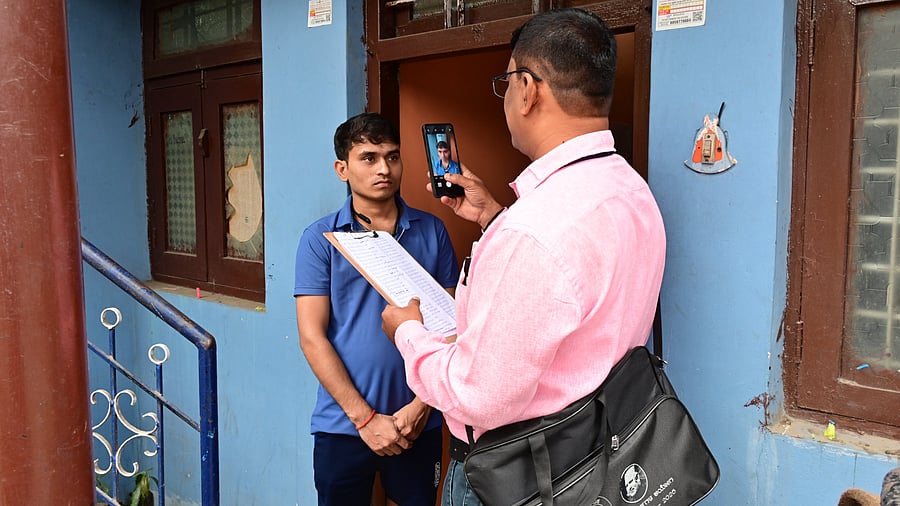
The social and educational survey, aimed at gathering socio-economic data of the citizens, was launched with great fanfare, but the reduced remuneration has left many surveyors feeling exploited.
Credit: DH file photo
The Karnataka State Commission for Backward Classes (KSCBC) is expected to submit its report on the social and educational survey to the state government by February-end.
KSCBC Chairman Madhusudan R Naik told DH that the report may be submitted within a month. According to the commission sources, the data is being analysed, and might take another 10-15 days. Once the report is ready, it will be translated into Kannada and then submitted to the government, sources added.
Initially, the commission had been asked to submit the report by December-end.
Speaking to DH, Backward Classes Welfare Department Minister Shivaraj Tangadagi said: “Data from across the state needs to be analysed and it will take some time. There’s no deadline as such but the chief minister has asked them to give it soon.”
The survey is politically contentious. While it has historically been criticised by the dominant Lingayat and Vokkaliga communities, minorities, Dalits and backward classes have supported it.
Amid the power tussle between Chief Minister Siddaramaiah and his deputy D K Shivakumar, it is expected that Siddaramaiah — a vocal proponent of the survey — may insist that the report is taken forward during his tenure itself (in the event of a possible change of chief minister).
The Karnataka High Court had asked the commission not to share the data with anyone, including the government. However, sources clarified that this only applied to the process of preparing the report. Once the report is prepared, there is no bar on the commission from submitting it to the government, a source added.
The physical leg of the social and educational survey was conducted between September 22 and October 31. The online self-enumeration was extended till November-end.
After the physical leg ended, the KSCBC had declared that 6.13 crore out of 6.85 crore people (89.48%) had been enumerated. However, KSCBC Member Secretary K A Dayananda told DH that this figure included households that had refused to disclose information.
“After filtering, we found that 5.86 crore persons participated in the survey (the population estimate considered by the commission was 6.85 crore) and that data is being analysed. The remaining 1 crore or so include persons who did not disclose information, houses which were locked and so on.”
Secondary data
Dayananda explained that the commission had now collected secondary data related to caste from educational institutions and government offices.
“This time, we have collected caste-wise data from the Karnataka Examinations Authority (KEA) about admission in medical, engineering, ayurvedic, degree and PU colleges. Similarly, caste-wise data has also been collected from all government departments, boards and corporations,” he added.
Secondary data is deemed crucial as it provides a clearer picture of the education levels of each community and the extent of reservation obtained by different communities in government jobs.
In 2015, the H Kantharaj-led commission had conducted a social and educational survey. Based on this, the K Jayaprakash Hegde-led commission prepared a report.
Last June, Siddaramaiah decided to conduct another survey, as the previous survey was 10 years old, and the KSCBC Act, 1995, mandates the revision of the backward class list once every 10 years.