
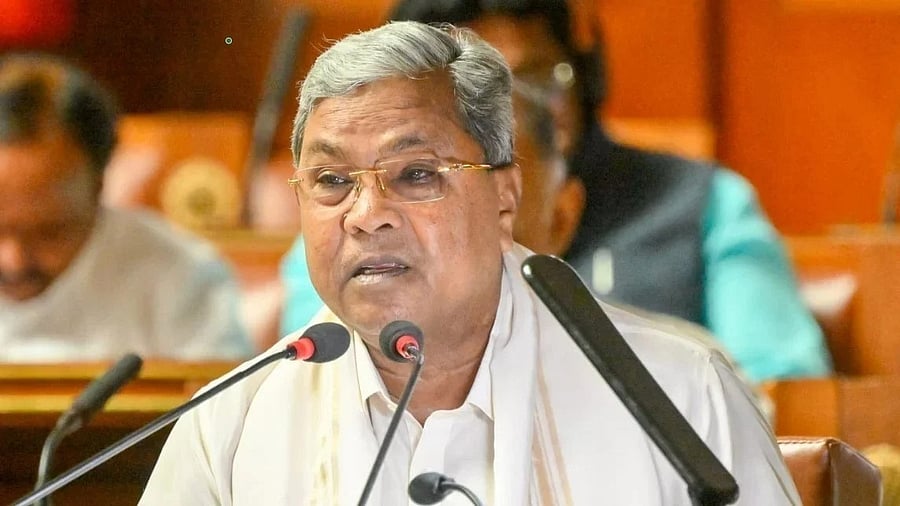
Karnataka CM Siddaramaiah
Credit: Karnataka CMO
Bengaluru: A decade and a half after spending Rs 32,000 crore to fight regional imbalance, the number of backward taluks in Karnataka has increased to 177, a high-power committee has found, concluding that “backwardness is predominantly a North Karnataka phenomenon”.
The Karnataka Regional Imbalances Redressal Committee, headed by economist M Govinda Rao, submitted its report to Chief Minister Siddaramaiah recently.
According to a summary of the report, which DH has accessed, the committee has asked the government to allocate Rs 43,914 crore towards redressal of regional imbalances between 2026 and 2031.
The previous committee headed by economist DM Nanjundappa had found 39 taluks as ‘most backward’, 40 as ‘more backward’, 39 as ‘backward’ and 61 as ‘developed’. At the time, Karnataka had 175 taluks. Now, there are 236 taluks.
Using its own methodology, the Rao committee has found that 59 taluks are ‘most backward’, 59 are ‘more backward’, 59 are ‘backward’ and 59 are ‘developed’.
The committee noted that Karnataka had recorded “spectacular growth” in income with an increasing share in India’s GDP.
“Despite this impressive growth credential, Karnataka is a state of contrasts. Curiously the high growth performance has not fully translated into commensurate improvement in social indicators,” the committee said. “This is mainly because the increase in income is concentrated in only a few districts, and large parts of the state still suffer from acute backwardness.”
Only six districts have a Net District Development Product (NDDP) above the state average -- Bengaluru Urban, Bengaluru Rural, Chikmagalur, Dakshina Kannada, Tumakuru and Uttara Kannada.
Based on the recommendations of the Nanjundappa committee, the government spent Rs 32,610.24 crore from 2007-08 to 2022-23. “Allocating more money does not necessarily improve the developmental outcomes in backward taluks and districts if it does not result in the creation of conditions for sustained growth and development,” the Rao committee said.
Within North Karnataka, the Kalyana Karnataka region has emerged as the centre of the backwardness problem. “Not a single taluk in the Kalyana Karnataka region is in the ‘developed’ category,” a member from the Rao committee pointed out.
According to the report, the Kalaburagi division has the largest concentration of ‘most backward’ taluks, followed by Belagavi. “In both Bengaluru and Mysuru divisions, there are no ‘most backward’ taluks,” it said.
The Rao committee flagged “conceptual and methodological shortcomings” with its predecessor. The Nandjundappa committee did not use per-capita income as a factor to determine backwardness, it said. The Nanjundappa committee assumed that the redressal of backwardness can be done “simply by incurring additional expenditures on infrastructure and services”, the Rao panel said. “It also assumes that the task of development is that of the government alone.”
'Abolish Malnad, Bayaluseeme boards'
The Govinda Rao committee has recommended the abolition of the Malnad Area Development Board and the Bayaluseeme Development Board as "their functioning has not made much impact in redressing the backwardness in these regions".
The committee also said that the Kalyana Karnataka Region Development Board (KKRDB) should be "reoriented to focus on its overall objectives".