
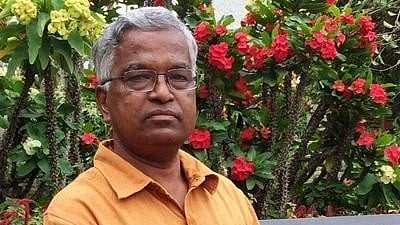
Kannada Development Authority (KDA) Chairman Purushothama Bilimale.
Credit: X/@PurushothamaBi1
In an interview with DH’s Naina J A, Kannada Development Authority (KDA) Chairperson Purushothama Bilimale discusses the challenges faced by Kannada-medium schools in border areas. He emphasises the importance of mother-tongue education and the need for sustained efforts to preserve and promote Kannada.
How do you view the implications of the Malayalam Language Bill 2025, passed by the Kerala Legislative Assembly?
As per the Constitution, all states have the right to protect their respective languages. Accordingly, Karnataka enacted the Kannada Language Comprehensive Development Act, 2022, which seeks to promote Kannada by mandating its use in official documents, education and public signage. However, Clause 6 of Chapter 3 of the Malayalam Language Bill 2025, makes Malayalam compulsory as first language in all government and aided schools from Classes 1 to 10. The Kerala government should amend this clause to clearly state that it does not apply to linguistic minorities in the state, in order to safeguard Kannada and other minority languages.
What has the KDA done in this regard?
I have written to the President of India urging the invocation of constitutional provisions under Article 350(B) for the appointment of a Special Officer. The proposed officer’s role would be to visit the concerned areas, assess issues relating to safeguards for linguistic minorities and report to the President. This would help ensure the protection of their rights and promote national integration by preserving linguistic diversity. I had earlier written to the President on border-related issues in Belagavi.
What are your suggestions to resolve the issue?
My concern is that states should not engage in conflicts over language. When states clash over linguistic issues, it weakens India as a whole. Instead, the concerned states — Karnataka and Kerala in this case — should constitute a committee of linguists and educationists to arrive at a long-term solution, as there is still a long way to go.
What are your views on the appointment of Marathi- or Malayalam-speaking teachers in Kannada-medium schools?
In 2024, the Maharashtra government appointed Marathi-speaking teachers to Maharashtra-run Kannada-medium schools in Solapur and Sangli districts. Similar appointments have also been made in Kasaragod. Recently, a Malayalam-speaking teacher was appointed at an anganwadi centre near Badiadka following the retirement of a Kannada-speaking teacher.
Marathi is an Indo-Aryan language, while Kannada is a Dravidian language. Their grammatical structures and teaching methodologies differ significantly, making such appointments inappropriate for effective teaching and learning.
How do we address the challenges — both academic and infrastructural — faced by Kannada-medium schools in the border regions of Maharashtra, Andhra Pradesh, Kerala and Tamil Nadu?
The challenges being faced by Kannada-medium schools are not confined to border areas alone; similar issues persist even within Karnataka, where enrolment is steadily declining. In border regions, Kannada-speaking teachers are not being appointed adequately by the respective states. Collectively, we have failed to convince people of the importance of education in the mother-tongue which is essential for a child’s overall development.
However, there is some hope for strengthening Kannada-medium schools in border areas, with the Karnataka Border Area Development Authority now placed under the State Planning Commission and a minister being put in charge. Budgetary allocations to the Authority are likely to increase in the coming years, which would help improve educational infrastructure in these regions.
Kannada cannot be preserved through government orders alone. Collective efforts are required to protect and strengthen Kannada-medium schools everywhere.
There are allegations that the reservations introduced for Kannadigas in border regions and outside the State are not being implemented effectively. What is your response?
In the interest of Kannadigas living in border areas and outside Karnataka, the Kannada Development Authority has urged the State government to ensure the effective implementation of the 5% reservation introduced in 2011 for admissions to higher education and professional courses. Students who have studied from Classes 1 to 10 in Kannada medium anywhere in India are eligible for this reservation. I have been writing to the government every year seeking its effective implementation. However, due to administrative negligence, the reservation has not been implemented effectively.