
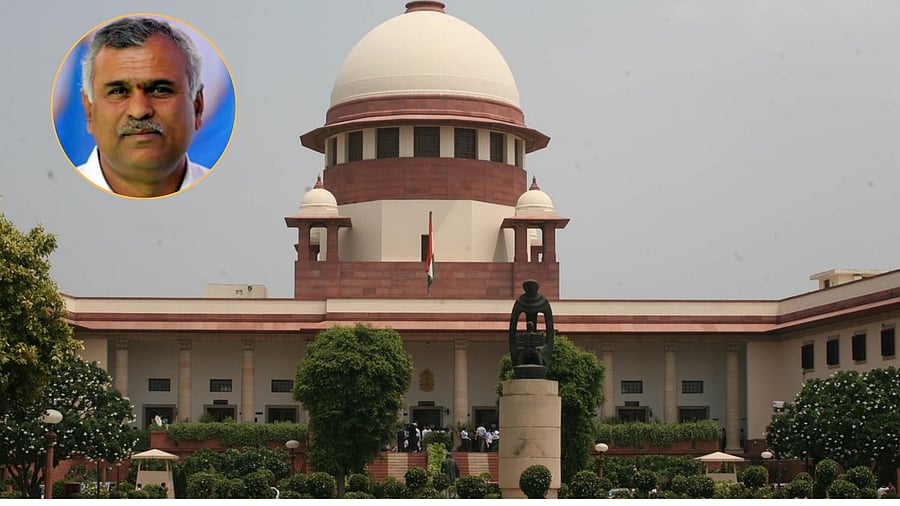
A bench of Chief Justice of India Surya Kant and Justice Joymalya Bagchi noted that even after the recounting of the votes, Nanjegowda secured 250 more votes than his opponent K S Manjunath Gowda from BJP.
Credit: PTI Photo, DH Photo
New Delhi: The Supreme Court on Thursday set aside the Karnataka High Court's judgment which annulled the election of Congress member K Y Nanjegowda as MLA from the Malur constituency (Kolar district) in the Karnataka assembly elections of 2023.
A bench of Chief Justice of India Surya Kant and Justice Joymalya Bagchi noted that even after the recounting of the votes, Nanjegowda secured 250 more votes than his opponent K S Manjunath Gowda from BJP.
The court thus upheld election of Nanjegowda.
During the hearing, the bench opened the sealed cover in the presence of the parties. The court found that even after the recount, Nanjegowda is the winner, as he secured 50,957 votes and Manjunath Gowda got 50, 707 votes.
"That being so, the election of the candidate from Malur remains unaffected even after compliance with the direction of recounting of votes issued by the high court. Consequently, we allow this appeal, to the extent that the impugned decision of setting aside the election of appellant is set aside and the election of the appellant from Malur is upheld," the bench said.
The apex court had on October 14, 2025 stayed the High Court's order and directed the Election Commission to comply with the directions to the extent of recounting of votes and submit the result in a sealed cover before this court.
A petition was filed by K S Manjunath Gowda of the Bharatiya Janata Party, challenging the election, on the alleged irregularities in the Karnataka Assembly election.
Gowda lost to Nanjegowda by a narrow margin of 248 votes in the 2023 elections.
He filed the plea for declaring Nanjegowda’s election as void. He also sought recount of votes, and declaring him as the elected candidate.
Gowda alleged votes were improperly accepted in favour of Nanjegowda and votes favouring him were rejected. The video recordings, which could have verified this, were withheld. The counsel also alleged that the returning officer had not passed any order on the petitioner’s recount application.
The High Court allowed his plea, observing the absence of records from the presiding officer made the election’s outcome questionable.