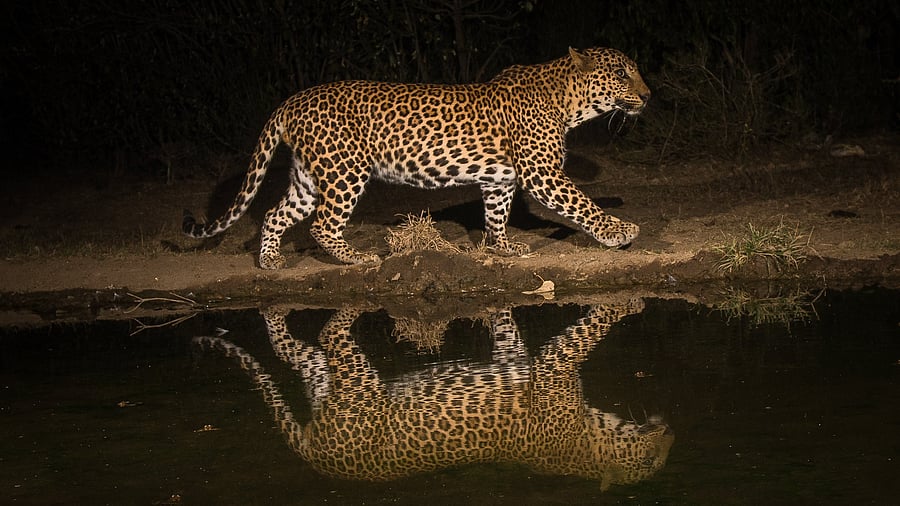
The very invention of trail cameras in the United States of America in the 1880s was for hunting. Bulky, wired cameras were placed along the probable tracks of white-tailed deer to understand the movement of what hunters then called the ‘vermilion deer’, largely to prevent crop raids.
More than a century later, similar technology, now far more refined, has taken on a radically different role. Unmanned trail cameras have evolved into critical tools for wildlife protection and conservation. Camera trapping of wild animals today is as much a science as it is an art, enabling experts to capture rare and elusive species in habitats where their very existence was once doubted.
While camera traps allow wildlife photographers to push the limits of creativity, they also help conservationists communicate the scale of conflict and survival challenges faced by various species.
Camera trapping is considered one of the most effective methods for studying highly elusive species in their natural habitats without disturbing them. It is through this technology that experts have recorded the presence of melanistic tigers in Simlipal, Odisha, smooth-coated otters in Nandhaur Wildlife Sanctuary in Uttarakhand, the Asiatic Caracal in Jaisalmer, and several other rare species. In Karnataka, the silent presence of camera traps in Kodagu revealed the secretive lives of the brown mongoose, white-tailed common civet and other mammals.
In India, researchers, forest officials and wildlife photographers primarily rely on two non-invasive camera-based technologies. The first involves trail cameras that capture comparatively low-resolution images, mainly used in surveys and scientific studies. The second is camera trapping, which employs advanced Digital Single-Lens Reflex (DSLR) cameras, multiple flash-light units and motion sensors to capture high-resolution images of animals in their natural habitat.
“It takes months and sometimes years of trial and error to get one decent image of a target species. There is a 90% chance of failure while trying to capture an animal in its natural habitat,” says Mysuru-based wildlife photographer Pruthvi B, winner of multiple international awards, including the prestigious Nature inFocus award. His award-winning image of a female leopard teaching its cub how to survive in an urban jungle was captured using a camera trap. Interestingly, almost all his photographs of tigers, leopards, deer, and other wildlife were taken outside protected areas, in and around Mysuru.
Setting up a camera trap to produce an artistic image is a science in itself. The equipment—cameras, flashes, and sensors—must blend seamlessly with the surroundings to avoid disturbing the animals. The artificial light should be subtle, never harsh enough to spook the subject.
“Camera trapping is one of the most expensive and difficult forms of wildlife photography,” Pruthvi explains. “The number of variables beyond our control is far greater than during a jungle safari. The camera must trigger the shutter instantly when the sensor detects movement. Artificial light sources must flash simultaneously, and, most importantly, the animal must be within the focal area. And all this has to happen in our complete absence.”
According to him, such precision is possible only with deep knowledge of the target species, which often comes from years of observation, trial and learning. “For a good image, animals must gradually get accustomed to the cameras and understand that the flashing lights pose no threat,” he adds.
Experts say elephants are among the hardest animals to capture on camera traps, as they often end up damaging the equipment.
During a jungle safari, one might spot 10 to 15 species of animals. But the real treasures of the forest reveal themselves in the pitch of darkness. Camera traps have proved invaluable in documenting these lesser-known and elusive species.
A detailed pre-installation study of the habitat and animal movement is crucial, says Yashpal Rathore, a Rajasthan-based camera-trapping expert credited with documenting the presence of black tigers in Simlipal for the first time. He has also worked extensively in Bhadra Tiger Reserve, Sandur valley, Kodagu, and other parts of Karnataka, capturing animal-habitat interaction involving species such as tiger, elephant, palm civet cat, porcupine and others.
“Camera traps give us insights into elusive species that are difficult to study through conventional fieldwork. They allow us to monitor wildlife without disturbing them, reducing the risk of behavioural changes and leaving minimal footprints in protected habitats,” he says.
For better conservation strategies
According to Yashpal, camera traps generate high-quality data on animal behaviour, habitat use, population dynamics, feeding patterns, social interactions and predator-prey relationships. “With the data collected, we can design effective conservation strategies to protect endangered species and fragile ecosystems,” he adds.
For the forest departments across the country, trail cameras have become indispensable—not only for wildlife surveys, including nationwide tiger estimation exercises, but also as invisible eyes guarding protected areas. There have been numerous instances in which officials have traced and arrested poachers using images captured by these cameras.
In Karnataka, the forest department is using camera traps to trace the movement of mammals. Recently, the department was able to scientifically track the movement of a male subadult tiger from Nagarahole to Karwar, using camera traps and without human intervention.
They usually place a camera trap near water bodies in summer to study species density, behaviour, and other characteristics.