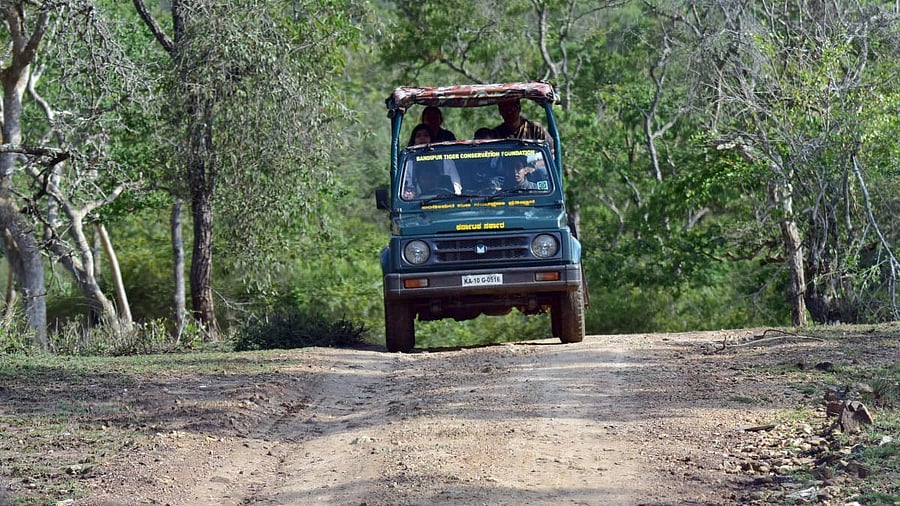
Tourists on a safari in Bandipur forest.
Credit: DH Photo
Mysuru: Tourism stakeholders and resort owners around Kabini backwaters, and the Nagarahole and Bandipur Tiger Reserves said the safari ban in Bandipur and Nagarahole has dealt a major blow to the region’s tourism sector and the local communities dependent on it. They urged authorities to lift the ban at the earliest by formulating SOPs(Standard Operating Procedures)
During a joint press meet on Thursday evening, tourism stakeholders stressed that safaris are the lifeline of the sector and local communities. They noted that safari tourism provides direct employment to many residents of nearby villages, including drivers, naturalists, guides, lodge staff and other support workers.
The stakeholders added that thousands of people—such as butchers, dairy farmers, farmers, vegetable vendors, small traders, transport operators and artisans—also depend on tourism-driven income.
They said that when local communities become partners in tourism, wildlife conservation naturally turns into a shared responsibility. Safari staff, they noted, often work much like forest patrol teams—discouraging illegal activities and reporting any violations promptly.
They added that with strict Standard Operating Procedures in place, allowing safaris would also enable responsible visitors to contribute by monitoring and reporting disturbances inside the forest.
Safaris, they stressed, not only promote awareness about wildlife conservation but, also safeguard the livelihoods of many families. Hence, they appealed for the ban to be lifted at the earliest.
Mysuru Travels' Association President B S Prashanth, said that Safari ban has affected even State Tourism at large, as several foreigners are diverted to other States, he said.
Mysuru Hotel Owners’ Association, president C Narayanagowda felt that the state government should have held meeting with stakeholders and considered their livelihood before they banned safari.
SKAL International Mysuru president C A Jayakumar felt that the state government must study the issue of man-animal conflict and address the issue scientifically instead of banning safari.
Several other tourism stakeholders and even taxi drivers, safari workers, nearby villagers and others who depend on the safari tourism were present in the press meet.
Human-animal conflicts
The safaris in NTR and BTR were banned from November 7 owing to demands by farmers' organisations, followed by four back-to-back incidents of human-animal conflicts between October 26 and November 7 in the fringes of BTR in Sargur taluk of Mysuru district resulting in deaths of three farmers and injury of one person.
Farmers' leaders had claimed that, safaris, along with the sound and lights from vehicles, intruded on animals’ private space and disrupted their activities. As a result, they said, wildlife tended to move toward safer areas and the forest fringes, increasing the chances of human–animal conflict.
However, there were no reports of such conflicts in areas around the safari zones. Forest department officials noted that incidents of conflict have, coincidentally, declined ever since the safari ban was imposed.