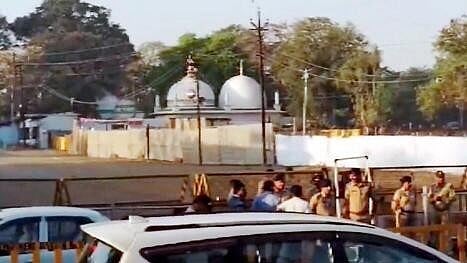
Bhojshala-Kamal Maula Mosque complex
Credit: PTI Photo
Dhar: Amid tight security, thousands of Hindus performed puja to mark Basant Panchami and a handful of Muslim devotes offered namaz at separate locations within the disputed Bhojshala-Kamal Maula Mosque complex in Madhya Pradesh's Dhar district on Friday.
No untoward incident was reported in the entire district, officials said, as the administration made arrangements for both the communities to worship and offer prayers at the 11th century monument in accordance with the Supreme Court's directive.
Around 8,000 security personnel were deployed in the area, turning it into a fortress.
Thousands of Hindu devotees offered `akhand' or continuous prayers to Goddess Saraswati, also known as Vag-devi, from sunrise to sunset. Elsewhere in the same premises, 15 to 17 Muslim devotees offered Friday prayers between 1 pm and 3 pm.
"Following the Supreme Court's directives, a meeting was held with both the parties and they were briefed about the arrangements. Both the parties were given separate places to observe their respective religious practices," said District Magistrate Priyank Mishra.
The puja as well as namaz were performed without any hindrance, and peace and order prevailed throughout the district, he added.
Dhar resident Imran Khan, however, alleged that officials took about 20 Muslims to the complex, telling them that they would be offering namaz in the mosque within the premises, but it did not materialise.
"We were kept at a location near the mosque, but no official came to meet us later, and we were unable to offer namaz there. The administration has betrayed us," he said.
Asked about the allegation, District Magistrate Mishra said, "I would not like to comment on this. I will only officially say that 15 to 17 members of the Muslim community offered namaz peacefully at the designated place, as per the arrangements made in accordance with the Supreme Court's directives. The community had discussed the symbolic namaz with us beforehand."
As to the claim made by some other local Muslim residents that 'outsiders' were brought to offer namaz, the collector said, "I don't think the (Supreme Court's) directives mentioned where the people (worshippers) should be from."
Hindu devotees began arriving at the complex from sunrise. Members of the Bhoj Utsav Samiti began puja by installing an image of Goddess Saraswati amid chanting of Vedic mantras. The ritual of offering oblations in `havan kund' (fire pit) marked the beginning of `akhand puja' (continuous puja), and long queues of devotees were seen until dusk.
The site of worship was decorated with garlands of flowers and saffron flags. Security personnel were deployed in every corner of the disputed site.
As the day progressed, the number of Hindu devotees increased, and by noon, thousands, including a large number of women, arrived in a procession, carrying saffron flags.
"We are delighted. We made grand preparations for the Basant Panchami puja. We are grateful to the Supreme Court for allowing akhand puja at Bhojshala," Ashok Jain, a patron of the Bhoj Utsav Samiti, told reporters.
Sarika Sharma, who was present with her family, said, "We feel very happy to have a darshan of Goddess Saraswati on the occasion of Basant Panchami. We want a permanent solution to the Bhojshala issue soon."
Union Minister of State for Women and Child Development, Savitri Thakur, also offered prayers to the Vagdevi portrait.
"The Vagdevi temple is a center of our faith," she said, adding that she welcomed the Supreme Court's directives.
The Hindu community considers Bhojshala complex, protected by the Archaeological Survey of India (ASI), a temple dedicated to Goddess Saraswati, while the Muslims claim that it is Kamal Maula Mosque.
After controversy erupted over who has the right to offer prayers, the ASI in April 2003 issued an order, stating that Hindus can worship at Bhojshala every Tuesday and Muslims can offer namaz every Friday.
As Basant Panchami fell on Friday this year, both communities claimed the right to worship and offer prayers at the disputed complex. The Supreme Court on Thursday said the Hindus could worship at the site from sunrise to sunset, while Muslims could offer namaz from 1 pm to 3 pm.
The Vishwa Hindu Parishad (VHP), meanwhile, said it would build a grand temple of Goddess Vagdevi at the contested complex by 2034 after completing the legal process.
The proposed shrine will be on the lines of the grand Ram Temple constructed at Ayodhya, and will house the consecrated idol of Goddess Vagdevi which is currently in a London museum, said VHP International President Alok Kumar.
Addressing a large gathering before taking darshan of Goddess Vagdevi at Bhojshala, he claimed that the original temple dated back to 1034.