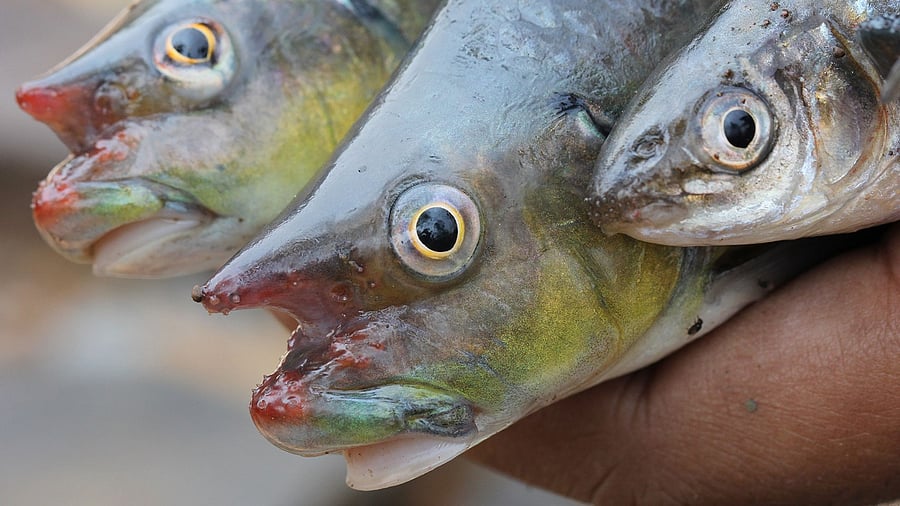
The BNHS is raising an awareness among the fishermen and traders on the importance of indigenous fishes.
Credit: BNHS Archives
Mumbai: With a larger goal of protecting the ecological chain and promote local businesses, the Bombay Natural History Society (BNHS) and Maharashtra government’s Department of Fisheries is working with fishermen in Ujani in Solapur district to improve their income by promoting indigenous fishes like Deccan Mahseer, Nukta and Rohu.
This innovative programme is going to bring a 360 degree shift in the fishery practices at Ujani reservoir from where tonnes of fish catch are supplied to Pune, Solapur, Mumbai and even other parts of India.
Nearly a fish catch worth Rs 4 to 7 crore is generated through fishery practices at Ujani.
Recently, the BNHS, which is headquartered in Mumbai, conducted a two-day workshop for Ujani fishermen which received good response.
The BNHS has started the Wetland Eco-Restoration programme at Ujani reservoir with the Irrigation and Fishery departments.
To bring this massive change in the fishery sector and provide the indigenous fishes to cities, BNHS trained around 120 fishermen as well as bird guides on how to change the practices and earn more by providing the delicacy of indigenous fishes to nearby cities.
“Hope these efforts will help to take Deccan Mahseer, Nukta, and indigenous Rohu (Labeo) species in large quantities to the market so that city people get this delicacy and good income goes to the fishermen, " said BNHS Director Kishor Rithe.
Dr Unmesh Katwate, a Senior Scientist of BNHS who is heading this project, said: “Ujani is potentially following the path of Bharatpur, a UNESCO World Heritage Site in Rajasthan, where the vanishing fish and bird populations led to the collapse of the entire ecological chain and local businesses.”
Anurag Mishra, President of the Cipla Foundation and Archana Shinde, Assistant Commissioner, Department of Fisheries, inaugurated the workshop.
The BNHS has planned several activities of Wetland Eco-Restoration and Fisheries Development with the support from the Cipla Foundation.
“Over the next fifteen years, the focus will be on conserving endangered fish and native plant species, with urgent efforts to eradicate invasive species such as African catfish, suckermouth catfish, and invasive plants like water hyacinth,” said Katwate.
BNHS and Department of Fisheries will soon sign a Memorandum of Understanding (MoU) to implement mitigation measures to control invasive fish species, including illegally farmed African catfish, and to collaborate on conservation breeding programmes for threatened native fish species of the Bhima River.
The BNHS is raising an awareness among the fishermen and traders on the importance of indigenous fishes, their importance in the ecosystem, conservation and how to reduce the spread of invasive alien species (IAS) in both plants and fish through systematic removal, introduction, and ecological management.
The workshop also discussed the plans to conserve native fish populations, introduction of native fish species from the Venna, Koyna, and Krishna rivers into the Ujani Reservoir. Breeding centres have also been proposed to get seed or fish larvae for the Deccan Mahseer.