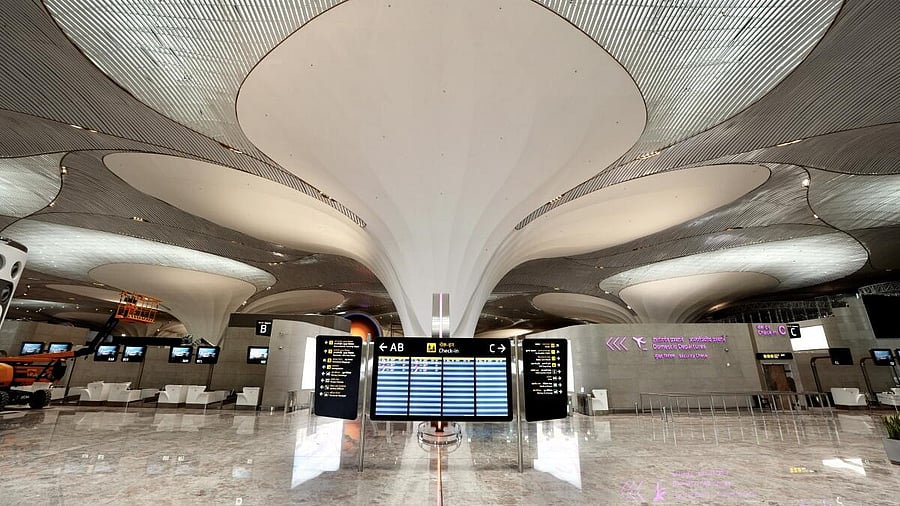
Interiors of the newly-constructed Navi Mumbai International Airport (NMIA) ahead of the inauguration of its first phase, in Navi Mumbai.
Credit: PTI
Navi Mumbai: Nearly two-and-a-half months after Prime Minister Narendra Modi commissioned the iconic Navi Mumbai International Airport (NMIA) at Ulwe in Raigad district, the first commercial flight will land at the new airport on Thursday, coinciding with the Christmas–New Year festive period.
With state-of-the-art facilities, a sustainability-driven design and future-ready capacity, NMIA is poised to redefine India’s aviation landscape and emerge as a new gateway to the nation.
On the inaugural day of operations on 25 December 2025, airlines including IndiGo, Akasa Air, Air India Express and Star Air will operate both incoming and outgoing passenger flights.
A total of 30 Air Traffic Movements (ATMs) are expected during the day.
The first flight to arrive at NMIA will be IndiGo 6E460 from Bengaluru, scheduled to touch down at 0800 hrs. Shortly thereafter, IndiGo 6E882 will depart for Hyderabad at 0840 hrs, marking the first outbound commercial service from the airport.
Prime Minister Modi had commissioned the world-class greenfield airport on 8 October 2025.
For decades, Chhatrapati Shivaji Maharaj International Airport (CSMIA) at Vile Parle–Santacruz in Mumbai, handling over 50 million passengers annually, has served as Mumbai’s sole international gateway, operating under significant capacity constraints.
The Adani Group-owned NMIA is expected to transform the Mumbai Metropolitan Region (MMR), encompassing Mumbai City and Mumbai Suburban districts along with large parts of Palghar, Thane and Raigad.
The new airport will usher Mumbai into a twin-airport model, comparable to global aviation hubs such as Dubai (DXB–DWC), London (Heathrow–Gatwick) and New York (JFK–Newark).
By 2032, NMIA’s projected capacity of 90 million passengers, combined with CSMIA’s throughput, will enable Mumbai to handle 150–160 million passengers annually, placing it on par with leading global aviation centres.
It may be noted that Mumbai International Airport Private Limited (MIAL) and the City and Industrial Development Corporation of Maharashtra Ltd (CIDCO) had formed Navi Mumbai International Airport Pvt Ltd (NMIAL) as a special purpose vehicle to develop, operate and maintain the project. The airport’s management was subsequently taken over by Adani Airport Holdings Ltd.
“The commencement of operations at NMIA reflects the Maharashtra Government and CIDCO’s sustained commitment to infrastructure development. This landmark project symbolises futuristic infrastructure, inclusive growth and enhanced global connectivity,” said Vijay Singhal, Vice Chairman and Managing Director, CIDCO.
CIDCO also lauded the Adani Group and NMIAL for delivering the iconic lotus-inspired terminal, which has already emerged as a powerful architectural symbol.
“The seamless coordination between the Government of Maharashtra, CIDCO, the Adani Group and NMIAL has ensured that NMIA stands today as a benchmark in modern aviation infrastructure and a proud new gateway for Maharashtra and the nation,” CIDCO officials said.