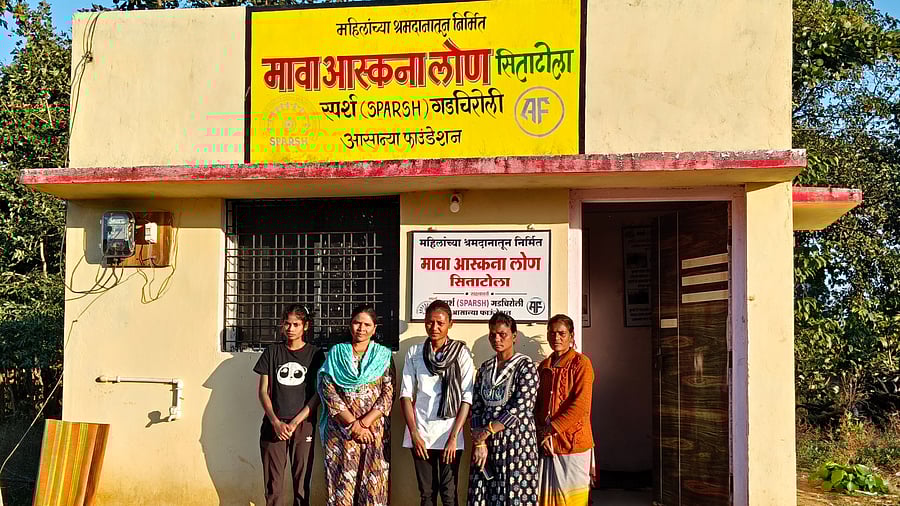
THEN & NOW: From ‘kurma-ghars’ (menstruation huts) to ‘mava askan lon’ (rightful home as women)
Credit: DH Photo/Mrityunjay Bose
Gadchiroli: A change is taking place in Maharashtra’s tribal-dominated Gadchiroli district, albeit slowly.
Tribal women, largely from the Madia community, have come together in Sitatola village near the Gadchiroli district headquarters to end the age-old practice of ‘kurma-ghars’ (menstruation huts) and built for themselves what is known as ‘mava askan lon’ (rightful home as women).
As part of practice and local beliefs, menstruating women live in these small, cramped huts known as ‘kurma-ghars’, without any basic facilities during their periods, isolated from the rest of the community. There is a lack of hygiene and security and in the past there have been instances of deaths. Food and water are provided from a distance, and they are forbidden from going to work or schools and colleges.
“A change is needed…in fact it is shocking that such practices continue even today. We have started in a small way to educate and inform people and we are getting good response,” said Dr Sachin Madavi, the Assistant Commissioner of Social Justice & Special Assistance Department in Gadchiroli district.
While Dr Madavi, who himself hails from the Madia community, is doing everything possible at the government-level to end the practice, his wife Dr Priyanka Shedmake, a gynaecologist, is educating the womenfolk about the need for change.
In fact, Dr Dilip Barsagade, the President of Society of People’s Action in Rural Services and Health (SPARSH), was one of the first to flag the issue of kurma-ghar and wrote to the National Human Rights Commission (NHRC) way back in 2013, which too expressed concern over the matter.
“Our volunteers are going to the villages and explaining to the people about the importance of a proper facility for women during the periods. Also, more importantly, we are very clear that a proper rightful home has to be built with shram-daan,” said Dr Barsagade, adding that the ‘mava askan lon’, which are located in the village is a proper concrete structure with a room with kitchen and toilet facilities.
Credit: DH Photo/Mrityunjay Bose
Credit: DH Photo/Mrityunjay Bose
Credit: DH Photo/Mrityunjay Bose
“So far, there has been a mixed response,” he said, adding that in the days to come SPARSH expects that more women will come forward to end the practice of ‘kurma-ghar’.
“We are talking to womenfolk individually and collectively and their response is good,” said Shubhanga Duga, a local volunteer. “It should be a people’s movement,” said Jyoti Khobragade. Volunteers like Chetana Madavi and Papita Kumbhre are making efforts to see that the practice ends.
“We have to stay in ‘kurma-ghar’…there is no option for us…more than women, the village elders and the menfolk too need to be explained,” a girl, who was on her period, said on condition of anonymity. "While there is support from family, what women need is community support," she added.
“This monthly occurrence, which is part of the process of reproduction, is a difficult time for women, especially young girls who need care since blood loss in large quantities leads to exhaustion. They need mental as well as physical support,” said Dr Madavi.
“There is an instance when a woman died of excessive loss of blood in Bhamragad. There is an instance of a girl being carried away by a wild animal. There are instances of snake bites. There are issues of people harassing girls and women living in gaokors,” said Dr Barsagade.
"The Sitatola village was a pilot for us...this has come up with shram-daan," he said.
Speaking on the overall situation, he said, "The Gadchiroli district has 1,638 villages. Among them, 1,311 villages have the presence of Madia tribes. We have a record of 1,900 plus kurma-ghars....the actual figure may be more. We have repaired 47 kurma-ghars across the district and have created this pilot project in Sitatola...this is going to act as a facility centre where issues of women's health among other things can be discussed."