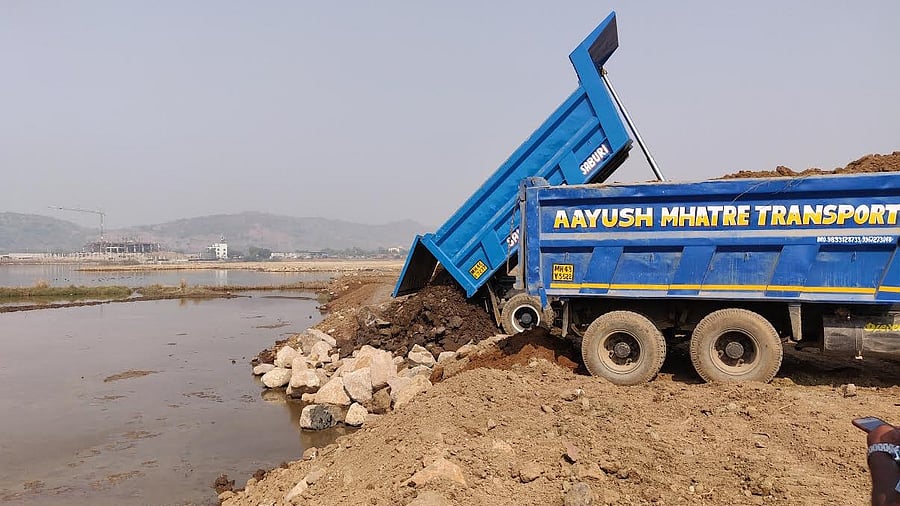
Dastan Phata Intertidal wetland.
Mumbai: Maharashtra has recorded official health cards for only 18 of its 23,046 major wetlands, leaving the state dangerously behind its peers, environmentalists said quoting official data.
According to the latest data on the Union Ministry of Environment, Forest and Climate Change’s (MoEFCC) Indian Wetlands portal, Madhya Pradesh leads the nation with 94 wetland health cards, followed by Odisha (77), Bihar and Tamil Nadu (71 each), Uttar Pradesh (58), Delhi NCR (56) and Jharkhand (43). Nationally, the gap is stark: of more than 200,000 wetlands larger than 2.25 hectares identified by ISRO’s National Wetland Inventory Atlas in 2010, only 684 have health cards in the public domain.
“This reflects the poor status of wetland conservation across India,” said B N Kumar, the director of the environmental watchdog NatConnect Foundation, calling the situation “highly regrettable” when the Centre speaks of preserving these ecosystems.
Prime Minister Narendra Modi has described India’s water bodies as Amrit Dharohar—precious heritage—yet the numbers tell a different story.
A wetland health card typically lists details of hydrology and catchment, biodiversity and governance such as mapping, management plan and notification.
Wetlands act as natural flood buffers, groundwater recharge zones, carbon sinks and biodiversity havens, yet urban planners treat them as “wastelands” for development, Kumar lamented.
The MoEFCC portal shows only 1,309 wetlands listed nationwide, including 91 internationally recognized Ramsar sites, against the NWIA list of over 200,000 major wetlands.
“The government announces Ramsar sites with great fanfare but neglects broader wetland conservation,” Kumar pointed out.
Maharashtra’s shortfall stems from an incomplete ground-truthing exercise—the physical verification of wetlands with latitude and longitude coordinates—assigned to the National Centre for Sustainable Coastal Management (NCSCM). Without ground-truthing, wetlands cannot be formally notified for protection. Documentation remains in progress, according to information obtained by NatConnect through a Right to Information Act (RTI).
The updated state wetlands map by the NCSCM shows hundreds of sites marked and coded and this reference point is much clearer than the NWIA on a 1:50,000 scale which just shows few blue lines, Kumar said and remarked that the documentation and notification still remain a far cry.
“Notification is vital under government rules,” noted Nandakumar Pawar, director of the NGO Sagar Shakti, part of the advocacy group Vanashakti. Pawar, who has been waging court battles to protect wetlands such as the 289-hectare intertidal waterbody at Panje in Uran, warned that developers exploit this legal vacuum.
Pawar and Kumar accused agencies such as CIDCO and JNPA of burying wetlands despite the official studies highlighting disastrous consequences.
Environmental groups have urged the state government to fast-track verification and notification of all major wetlands to safeguard their health as well as their benefits - water security, biodiversity and climate resilience.
Without swift action, Maharashtra’s wetlands—and the vital services they provide—face irreversible loss, NatConnect warned.