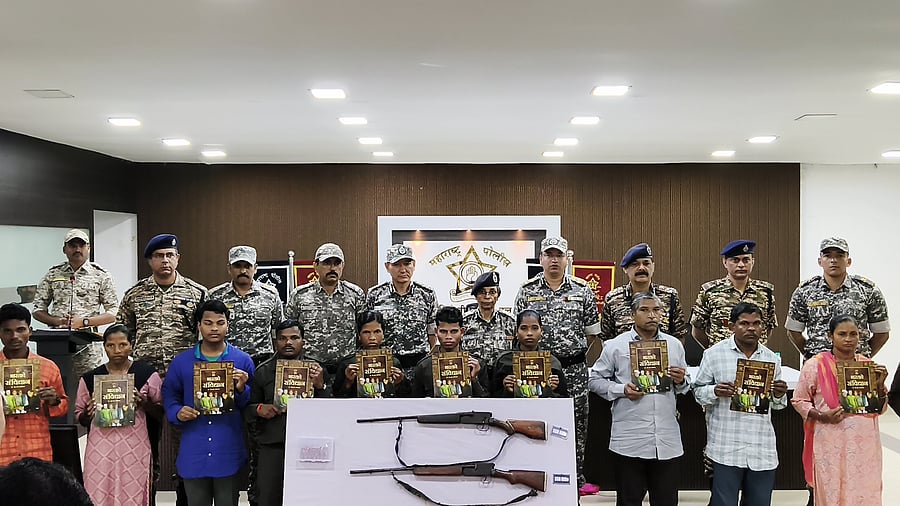
A group of Naxals surrendering before outgoing Director General of Police, Rashmi Shukla, in December, 2025.
PIC: MRITYUNJAY BOSE
I have been working as a journalist for three decades, and I have visited Gadchiroli half a dozen times, mostly to cover the Lok Sabha and Vidhan Sabha elections.
Located in eastern Maharashtra, the district has long been a hotbed of Naxalite activity. The dense forests in the region offer ample cover for the armed rebels.
On my most recent visit in December 2025, I could sense a distinct change. Residents moved about freely. This was in complete contrast to what I had witnessed in the past, particularly after the April 2018 twin encounters.
Seven years ago, the police had shot dead 40 Naxalites in the Boria Kasnasur jungles near the Indravati river in Bhamragad tehsil, and near the Rajaram Khandla post in the Jimalgatta forest in Aheri tehsil. The operation was jointly conducted by the C-60 commando team of the Anti-Naxalite Operations (ANO), the 9th Battalion of the Central Reserve Police Force (CRPF) and the Gadchiroli district police. I had reported from the conflict zones. The tension had been palpable then.
Since then, police jeeps and armoured vehicles have been replaced by heavy trucks transporting ore on smooth roads.
Surrender and rehab
Gadchiroli was among the districts worst affected by Naxalism. Many tribals who had joined the movement have now surrendered. They live in Navjeevan Colony in Gadchiroli town. The town houses the offices of the collector and the superintendent of police, besides the elite C-60 commando unit, which has played a major role in curbing Naxalism.
About 80 surrendered Naxals work in Lloyds Metal and Energy Limited (LMEL) at Konsari, 60 km from Gadchiroli town. They draw five-figure salaries. I travelled from Mumbai to the Konsari steel plant and met some former Naxals.
“Life is totally different now,” says 40-year-old Suresh Chamru Hichami. He joined the movement in 1999 and came out in 2007. He had served as a courier for his commanders, travelling between Nagpur and Mumbai.
Things changed in the mid-2000s when his sister got married to a policeman. “They started suspecting that I was an informant for the Naxalites. One day, I decided to get out of the movement,” he says.
For Govinda Atala, a former deputy commander of a dalam (squad or unit) of CPI (Maoist), the change is big. The 30-year-old says, “I am happy with my job. I now live my life on my own terms.” He works as the operator of a ring binding machine at the plant.
Atala had been enrolled in an ‘ashram-shala’ (a residential school for tribal and underprivileged children in the region). At 17, he left the school, following some of his classmates into the Naxal movement. “I underwent extensive training. I learnt how to use a carbine and an AK-47. After a few years, I realised this life was not for me,” he says.
When Mallojula Venugopal Rao alias Sonu aka Bhupathi surrendered on October 15, 2025, it was big news. He was a CPI (Maoist) Politburo member and part of its Central Military Commission. He once called the shots all along the Chhattisgarh-Maharashtra- Telangana border. It remains one of the most sensitive areas.
An ideologue and strategist, Bhupathi and 60 others surrendered before Maharashtra Chief Minister Devendra Fadnavis, who also holds the portfolios of home minister and Gadchiroli district guardian minister. Months earlier, on January 1, 2025, Bhupathi’s wife Vimala Chandra Sidam alias Tarakka, a member of the Dandakaranya Special Zonal Committee, had also laid down arms.
“In fact, 2024-25 has been significant in combating Maoism. A large number have surrendered after Bhupathi’s video appeal,” says superintendent of police Neelotpal.
Nambala Keshava Rao alias Kasavaraju, general secretary of the CPI (Maoist), was killed by a team led by Chhattisgarh police on
May 21, 2025.
“After that, Bhupathi convinced the commanders and cadres to lay down their arms. After Kesavaraju, Bhupathi had been the voice of the movement,” the police officer, known for his daring ways, says.
Gadchiroli’s District Collector Avishyant Panda believes Naxalism will soon be a thing of the past. “Gadchiroli is like any other district today. About Rs 3 lakh crore is being invested in the steel sector. This is expected to create 40,000 to 50,000 jobs. The district has massive quantities of superior quality iron ore,” he says.
A commerce graduate, Bhupathi was involved in plotting and executing several major attacks in the ‘red corridor’ for about 40 years. The ‘red corridor’ is a name given to regions of Maharashtra, Madhya Pradesh, Jharkhand, Chhattisgarh and Andhra Pradesh known for Naxal activity.
On November 24, 2011, Bhupathi’s brother Mallojula Koteswara Rao aka Kishenji (55) was trapped and killed by security forces in West Bengal’s West Midnapore district.
On September 13, 2025, Kishenji’s wife Pothula Padmavathi alias Kalpana (62) surrendered before the Telangana Director General of Police, Dr Jitender, in Hyderabad.
“Active Maoists must leave the path of violence, surrender, and join the mainstream to work among the people,” Bhupathi said in a video appeal days after his surrender. Hundreds of cadres laid down arms in Chhattisgarh and Telangana, and also in Gadchiroli, following his appeal.
His message: “We have realised that in the changing situation, we cannot wage an armed struggle. We are now working to solve the people’s problems under the Constitution.”
Many surrendered Naxals agree with him. “Sonu dada is correct. Many of my colleagues in the Naxal movement are no more. They died in encounters along the Maharashtra-Chhattisgarh border,” says a former rebel.
He says many like him were attracted to the movement at the Maoists’ village meetings. “We joined them and gave them our prime. But we got nothing in return. We now realise that we were wrong,” says the man, now in his 40s.
Many former Maoists work in the canteen of the LMEL plant. “Here, people have accepted us whole-heartedly. I would have never imagined that I would be able to start life afresh,” says Pramila Bohga, a 31-year-old woman.
She had joined the movement after watching street plays put up by Maoist groups operating in the region. “They would speak about ‘jal-jangal-zameen’ — causes close to our heart,” says Pramila, who was part of various Maoist groupings in Chhattisgarh and Maharashtra before surrendering in 2024. Her father had died in 2023, and she had been keen to return to her family and support them.
Most of the former rebels I spoke to stated that they were driven to the movement due to the issue of ‘jal-jangal-zameen’, poverty, socio-economic injustices and exploitation of tribals.
“Senior members of the rebel groups would come to our villages and speak to the people to join the movement. They would highlight the issues concerning the tribal community,” a surrendered Naxal said, referring to the Madia and Gond communities.
“The assurance that the movement represented the voices of the voiceless and gave power to the powerless was one of the driving factors,” another said, noting that the marginalised and underprivileged felt that taking up weapons was the way to bring in change.
Janu Hadu also works in the canteen. She and her husband, Sainu Hadu, now parents of two children, surrendered a few years ago. “I did sentry duties and military work in the movement,” says Janu, now in her 30s. “We will now be able to give better lives to our children.”
Nomadic life
Maoists lived a nomadic life, and even when they were unwell, they did not seek medical attention. Often, they had no contact with their families for months.
“All this was taking a toll on our health. We felt lonely and struggled with depression,” one of the surrendered Naxals says.
On June 6, 2025, Chief Minister Fadnavis, during his visit to the district, attended the wedding ceremony of a dozen surrendered Maoists. On that day, 12 Naxals surrendered. One of them was Sapana alias Sapanakka alias Swapna alias Papakka Buchayya Chaudhary, wife of Geereddy Pavanananda Reddy, a top functionary of the Dandakaranya Special Zonal Committee (DKSZCM), a division of CPI (Maoist).
LMEL managing director B Prabhakaran says he is ready to hire more surrendered Naxals. Vice president (corporate services) Col S K Mahapatra (retd) describes the former Naxalites as “sincere and disciplined”. The men work as drivers, welders, bar benders and crane operators, while the women are mostly employed in the canteens.
In Navjeevan Colony, they live in individual houses. They mingle with others and shop at the markets like anyone else. They get housing under various government schemes.
“There is a change now,” says Vijay Gawade, who hails from Udera village in Etapalli tehsil. He gave up his Maoist life about a decade ago. “I was part of a dalam that conducted military operations,” he says.
During his days in the movement, he walked from place to place, camp to camp, and crossed streams and rivers with backpacks filled with weapons and explosives.
“That was our routine. There was a constant threat of encounters. At some point, I began to feel I had to live a normal life like others,” says a former Naxalite, requesting anonymity.
Down to 10
“In January 2024, Gadchiroli had around 100 Maoists. Now we have barely 10. We are appealing to them to lay down their arms. We have a comprehensive surrender-cum-rehabilitation plan,” says Neelotpal.
The authorities are assisting former Maoists to pass Class 8 exams to help them qualify for courses of the Maharashtra State Skill Development Corporation.
“LMEL is already operational. JSW Steel will invest Rs 1.5 lakh crore in the next seven to eight years. Surjagad Ispat is developing a large, integrated steel plant in Gadchiroli. This would make Gadchiroli the biggest steel manufacturing complex in the world,” says District Collector Panda.
Education revamped
Primary and high school education is getting a boost in the region. Under a unique initiative, 71 libraries are now functional in Gadchiroli district.
In the last two-and-a-half years, 205 young men and women have been selected for the police force, and many others have secured jobs in the revenue department and other government departments.
MoUs have been signed by Gondwana University to set up colleges for undergraduate and engineering courses. The Gadchiroli Police Skilling Institute provides training in artificial intelligence (AI) and software development. Mahindra Tractors has entered into an agreement with the Maharashtra government to establish a skill development centre in Gadchiroli.
The Centre has set a deadline to end Naxalism — March 31, 2026, and sees Gadricholi as an example of how change can be ushered in.
Covered in thick forests and located in the Godavari river basin, the hilly district is a delight for naturalists, conservationists, paleontologists, meteorologists, archaeologists, mythologists, explorers, travellers and tourists.