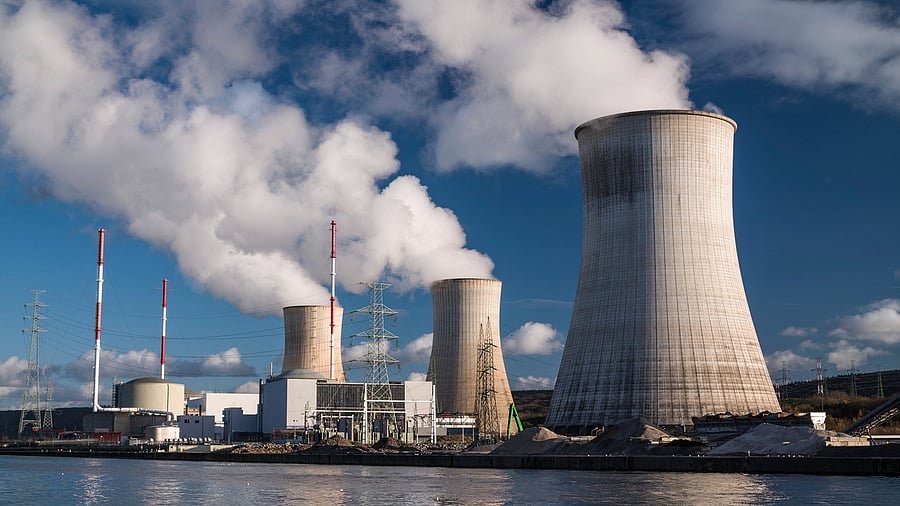
A representative image shows the cooling towers of a nuclear power plant.
Credit: iStock Photo
Mumbai: The Sustainable Harnessing of Advancement of Nuclear Energy for Transforming India (SHANTI) Bill, a reform which allows for a dilution of the monopoly of the Department of Atomic Energy (DAE) over India’s atomic energy sector is expected to unlock a potential of Rs 20 trillion–25 trillion, according to India Ratings and Research (Ind-Ra).
The rating agency expects that allowing private engineering, procurement and construction (EPC) players in India’s nuclear energy sector to provide a long-term sustainable order book for established entities, while the risks of liability persist.
“India’s SHANTI Bill opens the nuclear sector to private EPC players, unlocking a Rs 20 trillion–25 trillion opportunity for those with strong balance sheets, while success depends on risk-sharing and government support,” says Krishan Binani, Director, Large Corporates, Ind-Ra.
Previously, EPC entities have been receiving small package orders from the DAE and Nuclear Power Corporation of India Limited (NPCIL), mostly for the creation of civil infrastructure and supply of specialised materials. With the introduction of SHANTI Bill 2025, private players are expected to play an extended and pivotal role.
Ind-Ra suggests capping the private sector’s participation in the nuclear power sector at maximum of 49 per cent and minimum of 25 per cent, with NPCIL/government holding the remaining stake.
Typically, the cost per MW of a pressurised heavy water reactor is anywhere between Rs 150 million – 180 million (can exceed Rs 200 million), and the Voda Voda Energo Reactor costs between Rs 200 million – 250 million per MW.
Given the ambitious expectation of 100GW by 2047 and the timelines needed for the construction of such capacity, the order inflows and construction activities should be starting within the next five years (lead time of at least five to eight years).
The overall order inflows shall be Rs 200 billion – 250 billion per GW, and hence there is a massive order book potential of Rs 20 trillion – 25 trillion. While the entire order book might not flow to the private sector, a substantial amount of at least 25 per cent-40 per cent of the budgeted cost could give a boost to the EPC sector.
Ind-Ra believes that success of private sector participation depends on several factors, such as timely approvals for engineering & licensing activities, the availability of nuclear-grade concrete, limited domestic vendors, limited nuclear-qualified civil contractors, import dependencies subject to various geo-political issues, and major legislative hurdles, including nuclear liability risk (The Civil Liability for Nuclear Damage Act, 2010) and Atomic Energy Act 1962, which specifies the ownership to be with the government of India.