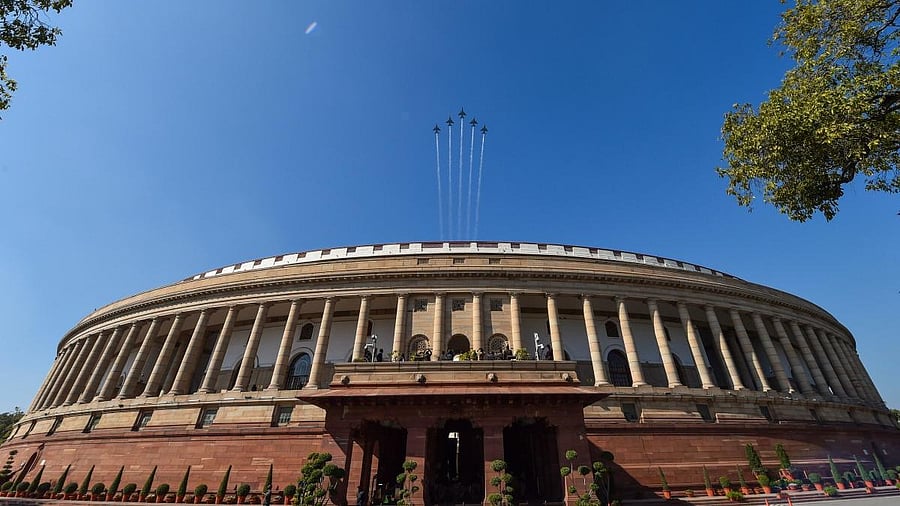
A representative image of the parliament.
Credit: PTI file photo.
New Delhi: A parliamentary panel on Friday asked the Centre to come up with the updated India's National Ambient Air Quality Standards "at the earliest", noting that the standards were last revised in 2009.
In a report tabled in the Lok Sabha on Friday, the Department-related Parliamentary Standing Committee on Science and Technology, Environment, Forests and Climate Change also recommended that all manual stations in Delhi-NCR be upgraded to continuous ambient air quality monitoring systems.
It observed that the current distribution of air quality monitoring stations in Delhi is "heavily skewed" towards central and southern parts of the city, which are relatively less populated, greener and more affluent.
The committee said this geographical bias leads to "a distorted and non representative dataset", systematically excluding more polluted, densely populated and less affluent areas.
The panel also noted that most of the six new continuous monitoring stations proposed for Delhi were again planned in relatively greener areas such as the JNU campus, while the trans-Yamuna region has "again been left out".
It "strongly" recommended that the Environment Ministry reconsider the sites for these six stations and evenly redistribute monitoring stations across Delhi and the wider NCR.
Raising concern over the high GST on air purifiers and HEPA filters, the committee said it was contradictory that while attempts to control air pollution have fallen short, a prohibitive tax is levied on a device citizens use for personal protection.
"Imposing such a tax effectively monetizes a public health failure. The committee feels that the citizens of the country should not be penalized for trying to save themselves from a catastrophic situation," it said, recommending that the government either abolish or reduce the GST.
The panel said delivery riders, traffic police personnel, bike taxi riders and similar groups are "more vulnerable to the hazards of air pollution" and called for targeted programmes for their protection.
These could include directing e-commerce and logistics companies to provide high-quality protective masks such as N95 free of cost, mandatory company-funded annual health check-ups with additional check-ups after severe pollution episodes and the creation of a dedicated health risk profiling and monitoring system.
It also recommended enforceable SOPs for high-pollution days, including limits on continuous outdoor exposure and ensuring access to indoor rest areas, along with targeted public health campaigns on protective measures.
It suggested that major public hospitals consider dedicated OPD counters for respiratory ailments to ensure "timely and hassle-free medical attention " for these workers.
The committee said the situation for children and the elderly becomes acute during peak winter pollution and they "cannot afford to wait for government policies to yield results".
It recommended installing air purifiers in all public schools of Delhi-NCR, especially primary wards during severe pollution, and in all public hospitals, including ICUs, pulmonology, maternity, neonatal and geriatric wards.
It also suggested making air purifiers mandatory in all government offices and incentivising private offices through tax rebates for installing purification systems.
The panel expressed concern that some thermal power plants around NCR remain non-compliant with sulphur dioxide norms and lack flue gas desulphurisation units despite their significant role in Delhi's pollution.
It said repeated extensions "may not be given" and recommended that the Power Ministry and the Environment Ministry ensure installation of FGDs as per the July 11, 2025 notification.
It further recommended that CAQM, the Environment Ministry and the Power Ministry conduct a monthly review of FGD installation and operationalisation in every non-compliant unit.
There are 11 coal-based thermal power plants within 300 km of Delhi-NCR, comprising 35 units with a total capacity of 13,560 MW. Of these, four plants with 14 units and a combined installed capacity of 5,350 MW lie within 10 km of the NCR boundary and must comply with SO2 norms by December 31, 2027.
The committee also highlighted that many organised-sector employees live in government or company-owned housing clusters, creating an opportunity for a common mobility solution.
It strongly recommended a dedicated fleet of fully air-conditioned electric buses to transport employees from these residential complexes to their offices.
A suitable monthly fee could be charged to recover costs and the move would ensure reliable attendance while significantly reducing private vehicle use and associated pollution, it said.