
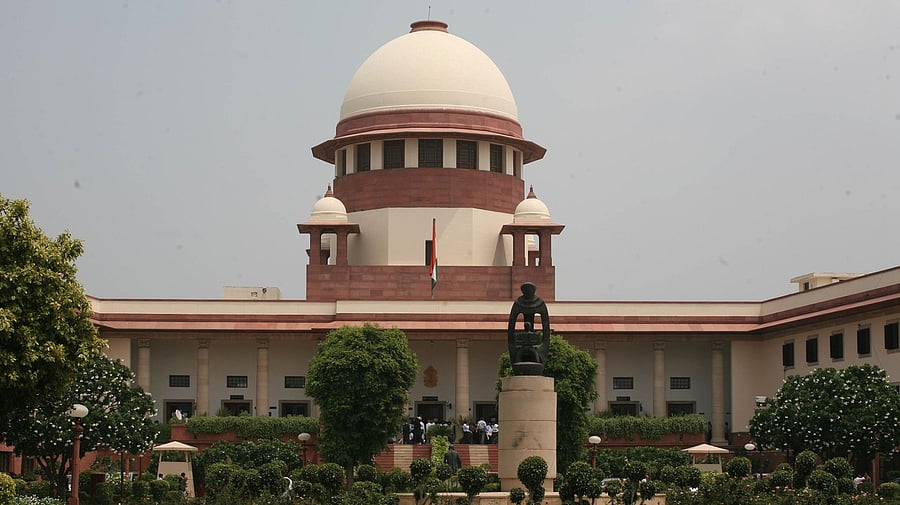
The Supreme Court of India.
Credit: iStock Photo
New Delhi: The Supreme Court has said the police or the investigating agency cannot undertake further investigation in a criminal case without taking permission from the court concerned.
A bench of Justices Rajesh Bindal and Vijay Bishnoi said, in the event, the police or investigation agency is of the opinion that further investigation is necessary in any particular case to cull out complete facts and truth in the case, it is binding upon them to file an appropriate application before the Magistrate or court, without directing an order for further investigation by themselves.
"The power to direct further investigation in a case rests solely at the discretion of the magistrate/court concerned and it is not for the police or investigating authorities to take a decision," the bench said.
Allowing an appeal filed by Pramod Kumar and others against the Allahabad High Court's judgment of November 20, 2023, the court examined whether after submitting a final report under Section 173(2) of the Criminal Procedure Code (also Section 193(3) of the Bharatiya Nagarik Suraksha Sanhita, 2023), the police or investigating agency can conduct further investigation under Section 173(8) of CrPC (Section 193(9) of BNSS) without obtaining the leave of the magistrate/court concerned.
Relying upon Vinay Tyagi Vs Irshad Ali (2013), the bench pointed out, this court, while noting that although there is no explicit mandate under Section 173(8) CrPC to seek the leave of the court before conducting further investigation, nevertheless, over time, a practice has been developed to seek permission of the court.
"Therefore, the practice of seeking the leave of the court will have to be read into the provisions of Section 173(8), and it is essentially a prerequisite for directing further investigation,'' the court underscored.
The court took exception to the decision of Superintendent of Police's order for further investigation in a case related to alleged gang rape for having acted in complete defiance of the procedure laid down under the law.
"It is an unbecoming conduct from the officer of such a rank to exercise unfettered powers, in excess of its jurisdiction, thereby undermining the authority vested in the court of law,'' the bench said.
In the 2013 FIR, the police filed a closure report in view of contradictions between the statements of the original complainant under Section 161 and 164 CrPC. The court accepted the report. However, after three years, the complainant challenged the acceptance of closure report before a sessions court.
In a separate proceedings, the NHRC issued directions to the Uttar Pradesh's Director General of Police to conduct probe against the police officers involved in the probe and pay compensation to the complainant.
The state government then ordered CBCID probe and directed for further investigation. The police collected blood sample of the accused and found the DNA sample did not match with aborted fetus of the victim.
The appellants approached the High Court which dismissed their writ petition against further investigation.
On their challenge, the apex court set aside the High Court's order and quashed the order for further investigation but clarified the pending revision petition against acceptance of the closure report would be decided on its own merits.