
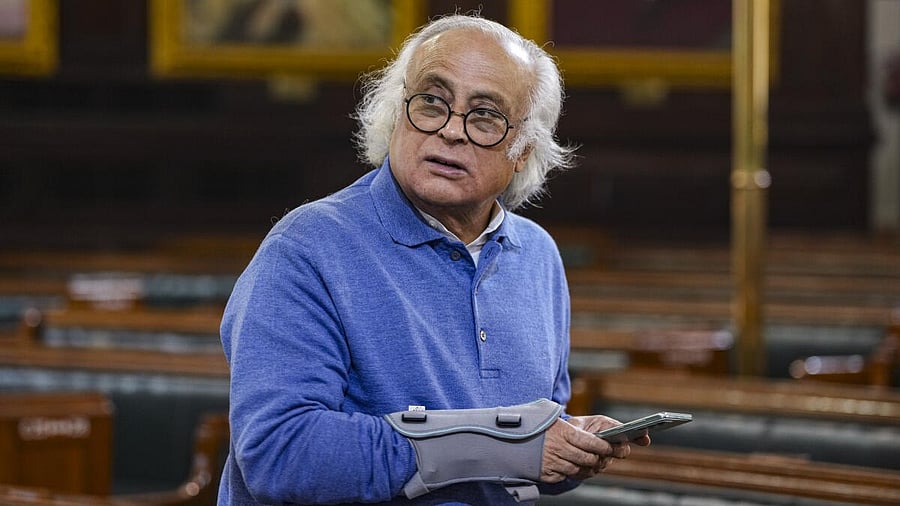
Congress MP Jairam Ramesh.
Credit: PTI
New Delhi: Notwithstanding the assurances given by the Union Environment Ministry on its protection, questions are being raised on the new definition of Aravalli with critics claiming a large part of the hill and range may not get the protection if mining permissions are given on the basis of the new definition, accepted by the Supreme Court.
While senior Congress leader and former Environment Minister Jairam Ramesh on Tuesday said he would be filing a petition in the Supreme Court in January, former Rajasthan Chief Minister Ashok Gehlot said the Central government was indulging in statistical jugglery to mislead people while weakening environmental safeguards.
According to the new definition accepted by the apex court, any landform rising 100 mt from the surrounding terrain will be counted as Aravalli hill. Two such hills at a distance of 500 mt and the land between the two, will be Aravalli range.
Environmentalists said such a definition by height would remove the protection on smaller scrub-covered hillocks, opening them to mining. The Forest Survey of India’s own analysis suggests “gentle terrain” in 23 Aravalli districts.
"The FSI should officially release the data on (i) the number of hills as per the FSI definition, (ii) the number of hills as per the 100 m definition and (iii) The area of Aravallis under both definitions," Chetan Agarwal, an independent forest and environment services analyst told DH.
“FSI may release the data for 15 Rajasthan districts for which it has already digitised the maps and contours for the report submitted to the Supreme Court,” he said.
The Aravalli hills and ranges harbour rich biodiversity with 22 wildlife sanctuaries, four tiger reserves, the Keoladeo National Park along with wetlands like Sultanpur, Sambhar, Siliserh, and Asola Bhati, and aquifers that recharge river systems including the ones at Chambal, Sabarmati, Luni, Mahi, and Banas.
The major portion of Aravalli is within the 15 districts of Rajasthan accounting for an area of 40,481 sq km, according to the FSI, while around 1,000 sq km is spread in seven districts of Haryana.
Though 37 districts have been described as Aravalli district by the Centre, hilly areas in the remaining ten districts – five each in Gujarat and Delhi - are marginal.
Union Environment Minister Bhupender Yadav claimed 1.44 lakh sq km area as Aravalli, but official data showed it was the total land mass of all the 37 Aravalli districts and not the hilly areas in those districts.
“The 1.44 lakh sq km figure is deceptive. It spans the entire landmass of the 34 Aravalli districts identified by the ministry in four states. This is the wrong denominator,” Ramesh said.
“In 15 of the 34 districts, the area under the Aravallis is 33% of the entire landmass. There is no clarity whatsoever about how much of these Aravalli areas will be excluded under the new definition and made available for mining and other developments,” he added.
Meanwhile, the Forest Survey of India on Tuesday categorically refuted claims that it had carried out any study saying that only 9% Aravalli is above 100 mt.
The Union Environment Ministry on its part said no new mining lease would be given till the Indian Council of Forestry Research and Education prepares the “Management Plans for Sustainable Mining” for each of the 37 districts as per the top court’s recommendation.