
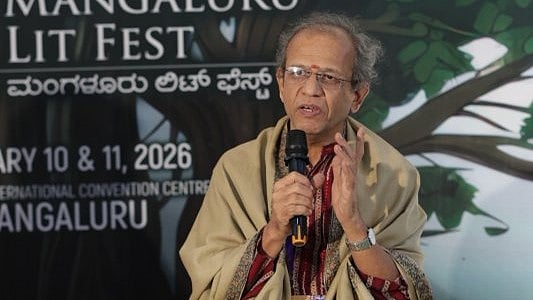
Shatavadhani Dr R Ganesh
Credit: X/@mlrlitfest
New Delhi: Shatavadhani Dr R Ganesh, a renowned practitioner of the ancient art of avadhana, polyglot, and author, has been conferred the Padma Bhushan, one of India's highest civilian honours, in recognition of his outstanding contributions to art and Indian cultural heritage.
The 63-year-old scholar from Karnataka is widely celebrated for reviving and mastering avadhana - an intricate performance art that demands extraordinary mental agility and multitasking skills.
In an avadhana performance, the artist must simultaneously compose extempore poetry in classical metres, solve complex mathematical puzzles, answer questions posed by multiple scholars, and maintain aesthetic grace and literary excellence throughout.
Dr Ganesh has performed over 1,300 avadhanas in four languages: Kannada, Sanskrit, Telugu, and Prakrit. He is renowned for his extempore composition of poetry, including intricate chitrakavya (visual poetry), during these sessions.
He is the only Śatāvadhāni (one who performs with 100 questioners) from Karnataka and is credited with single-handedly reviving the avadhana tradition in Kannada, which had no living practitioners when he began in 1981.
He has also authored numerous books in Kannada, Sanskrit, and English on topics ranging from classical literature and philosophy to cultural criticism.
Born in Kolar in 1962, Dr Ganesh holds a bachelor's degree in mechanical engineering from University Visvesvaraya College of Engineering, Bengaluru; a master's degree in metallurgy from the Indian Institute of Science; an MA in Sanskrit; and a DLitt from Hampi University for his thesis on avadhana in Kannada.
His linguistic mastery extends to Kannada, Sanskrit, Telugu, Tamil, Hindi, Marathi, English, Prakrit, Pali, Greek, Latin, and Italian, making him one of India's foremost polyglots.
Beyond avadhana, Dr Ganesh has enriched Indian performing arts by conceptualizing innovative formats such as a solo Yakshagana performance, Kavya-chitra-gita-nritya (a fusion of poetry, painting, music, and dance), and Raganuraga—a programme that introduced 120 classical ragas to wider audiences.