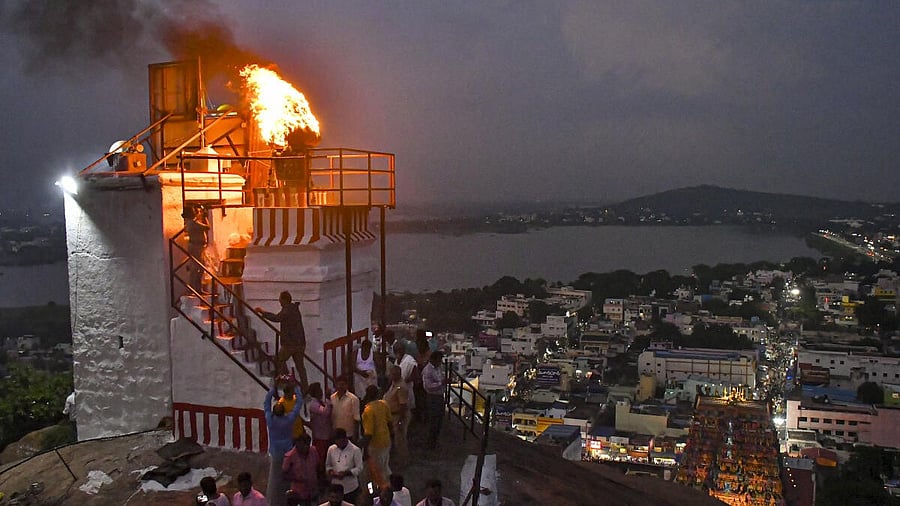
A lamp lit at Thiruparankundram temple as part of 'Karthigai Deepam' festival celebrations, in Madurai district, Tamil Nadu.
Credit: PTI File photo
Chennai: Upholding a single-judge bench order allowing lighting of lamp on Deepathoon (stone pillar) atop the Thiruparankundram hills in Madurai, the Madras High Court on Tuesday lambasted the DMK dispensation for failing to implement the verdict and terming as an “imaginary ghost” the apprehension of the probability of disturbance to public peace.
In a detailed 170-page order that began with a verse from The Bible, a division bench of justices G Jayachandran and K K Ramakrishnan directed the Thiruparankundram Murugan Temple administration to light the lamp at the Deepathoon on Karthigai Deepam (which falls between November and December) but disallowed public from participating in the ceremony.
Justice G R Swaminathan had on December 1 allowed lighting of the lamp atop the Deepathoon in Thiruparankundram but the temple management lit the lamp in Uchipillaiyar Temple as per the custom. Despite the judge initiating contempt proceedings and sending CISF personnel to accompany the petitioner, Rama Ravikumar, to light the lamp on December 3, the state government sent them back saying they will face the consequences.
Thiruparankundram hill has been a haven of religious co-existence and communal harmony for centuries, hosting the Subramaniya Swamy temple, Kasi Viswanathan temple, and Sikkander Badusha dargah. The government said it did not allow the lamp to be lit atop the hill since it feared there could be damage to dargah, located 50 metres from the Deepathoon.
'Imaginary ghost'
“We find that the apprehension expressed by the District Administration regarding probability of disturbance to the public peace is nothing but an imaginary ghost created by them for their convenience sake and to put one community against other community under suspicion and constant mistrust,” the judges wrote.
While the government said it would appeal against the order in the Supreme Court, BJP welcomed the judgement and hoped that the government will stop its "blatant misuse of power" and "respect the rule of law" by allowing lighting of the lamp.
The bench concluded that the state government and the dargah failed to produce formidable evidence to show that Agama Sastra of Shaivites prohibits lighting lamps at a place which is not straight on top of the deity in Sanctum Sanctorum.
'Political agenda'
In a stinging indictment of the administration, the court commented that it was “ridiculous and hard to believe the fear of the mighty state that by allowing lighting of the lamp at pillar on a particular day in a year, will cause disturbance to public peace."
“Of course, it may happen only if such disturbance is sponsored by the state itself. We pray no state should stoop to that level to achieve their political agenda,” the bench said.
The bench also unequivocally stated that it was the duty of the state government to maintain law and order and said it was an “unmanageable task” to keep the devotees stay at the foothill and worship when the light is lit atop the hills.
“Projecting as if such congregation will cause disturbance to peace, stampede, disharmony among community, etc. is either exposure of their incapacity to maintain law and order or hesitant to bring harmony among the communities,” the bench said.
The judges also added that the state should have taken the single-judge bench verdict as an opportunity to bridge the difference between the two communities – Hindus and Muslims -- and narrowed down the gap by peaceful negotiation.
“Unfortunately, due to lack of conviction, all these years the peace meetings have paved way only for widening the mistrust. We hope, by implementing the below directions, which can be suitably modified whenever a festival of the respective community falls, then there will be only light and not any fight,” they wrote.
Customs and traditions
The verdict also said the practice of lighting Deepam at a conspicuous place for worship by Shaivites on an auspicious day is not uncommon custom and opined that they were not able to find out any Agamasastra in Shaiva Siddhanta Thirumandiram or Maikanda Sasthiram that say Deepam on auspicious day should be lit only straight on the top of the deity.
Dwelling into the debate whether the pillar was a mere survey stone, the judges said being at vantage point, the stone Pillar called as Deepathoon, which is on the different rock summit and lower to the peak on which the dargah is located, is the ideal place to light Deepam. "Religious practices always carry a purpose."
“The practice of lighting Deepam at an elevated place during Karthigai Deepam festival and other festivals is for the devotees at the foothill and its surrounding to see and worship. In the result, the writ appeals are disposed of,” the judges wrote.
The judges directed the temple authorities to light the lamp at the pillar and asked the Archaeological Survey of India (ASI) to impose conditions appropriate and necessary to preserve the monuments in the hill, while maintaining that no public shall be allowed to accompany the team.
“The District Collector shall coordinate and supervise the event,” the judges added.
In the judgement, the judges also referred to four milestones in the form of judicial pronouncements regarding Thiruparankundram hills by the Privy Council in 1931, and that of the Madras High Court in 1996, 2014, and 2025.
The judges said the dispute is not just an enforcement of custom, but is sufficiently demonstrated that it concerns the enforcement of fundamental right of worship and expression, as well as protection of culture.
“In such circumstances, taking note of the silence of the authorities exhibited, consistently ignoring the plea of the worshippers for several years, requires interference under Article 226 of the Constitution of India,” they added.