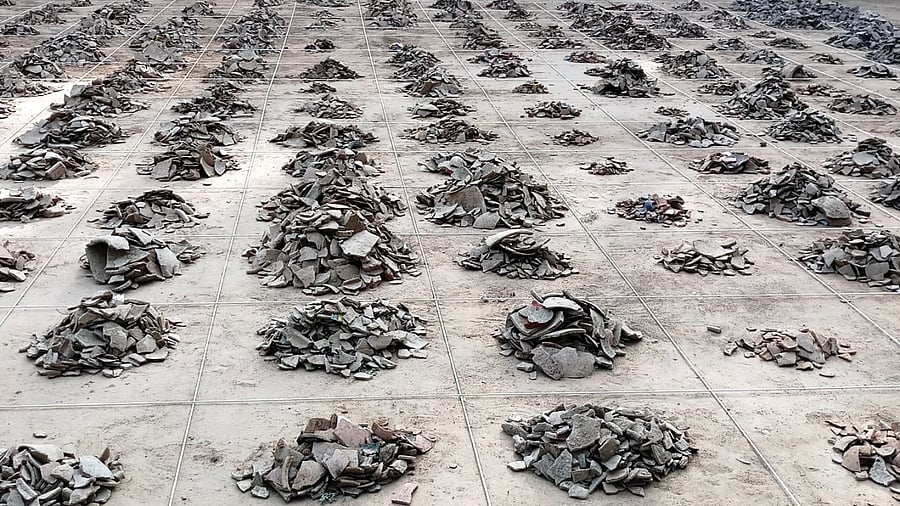
Keeladi archaeological excavation photos. Image for representational purpose.
Credit: Tamil Nadu State Department of Archaeology
Chennai: Standing by his 982-page report on excavations in Keeladi and demanding its immediate release, archaeologist K Amarnath Ramakrishna has outright rejected the 114-page “critical evaluation and recommendation” note of his report prepared by five officers of the Archaeological Survey of India (ASI), calling it “more mechanical” than factual.
The note prepared by archaeologists Priyank Gupta, Garima Kaushik, P Aravazhi, Hemsagar A Naik, and Nandini Bhattacharya Sahu, says the narrative of Ramakrishna on Keeladi blends historical background, literary references and research gaps without clear thematic divisions, besides commenting that it reduces readability and obscures analytical focus.
In a four-page note sent to the Director General, ASI dated February 3, according to sources, Amarnath objected to the officers asking him to improve his report based on their observations and alleged that their recommendations are beset with “serious and fundamental flaws.”
Ramakrishna, who discovered the Sangam Era site near Madurai in 2014, has been involved in a running battle with his employer, ASI, over the latter’s refusal to accept his report, which has derived Keeladi’s period to be between 8th century BCE to 3rd century CE.
In May 2025, two years after he submitted the report, the ASI asked Ramakrishna to “resubmit” the report, but the archaeologist declined to do so, following which five officers were tasked to evaluate the document.
In his response, Ramakrishna, sources told DH, said the content, nature of the language, structure, and overall presentation of the critical evaluation discloses “non-application of scholarly human mind” to the report and added that the findings were prepared by him upon carrying meticulous excavation and facts found in his research.
The archaeologist also alleged that the evaluation note seems to be a “product of AI-assisted) technology as it has been prepared in a “monotonous pattern” with repetitive and similar terminology being applied uniformly across the note. “The same is more obvious from the fact that the evaluation note is more mechanical,” Ramakrishna said.
Complaining that he was repeatedly asked to make changes to the report, Ramakrishna wondered why this was repeatedly happening to Keeladi excavation alone and claimed that such a “strange and unprecedented form” of scrutiny has never happened to any other excavation report.
The common practice in the ASI was to do a “thorough proofreading work” before any publication, Ramakrishna said, and alleged that in his case, the internal committee under the guise of undertaking such a process has exceeded its bounds by commenting upon the merits of the report.
“It (the note) virtually seeks to supplant my findings which are purely based upon careful consideration of the primary sources namely, from the archaeological excavation, cultural deposit, stratigraphical sequences and its material culture which were actually retrieved from the site,” he said.
However, Ramakrishna added, that it was “pathetic” that the committee never visited Keeladi and never visualised the cultural formation, cultural sequence, and cultural deposits and materials discovered by the excavation team.
Standing by his report, which he argued was in accordance with the principles and established methodology laid down by the ASI, Ramakrishna maintained that there is no need or valid reasons to alter the said report, much less to substitute the chronology of the site. He also said withholding the report further serves no purpose and asked the ASI to release it at the earliest.
Keeladi is one of the most politicised archaeological site in the recent past -- Ramakrishna was abruptly transferred to Assam in 2017, and his successor claimed that there were no “significant findings” in the third phase which led to a massive uproar with Tamil parties accusing the BJP of behind the move.
From the fourth phase, the Tamil Nadu State Department of Archaeology (TNSDA) took over the excavations in Keeladi -- about 20,000 artefacts have been recovered from Keeladi since 2014.
In recent years, Keeladi has become a symbol of Tamil pride, prompting renewed public interest in archaeology, coupled with the DMK government’s emphasis on the ancient glory of Tamils.