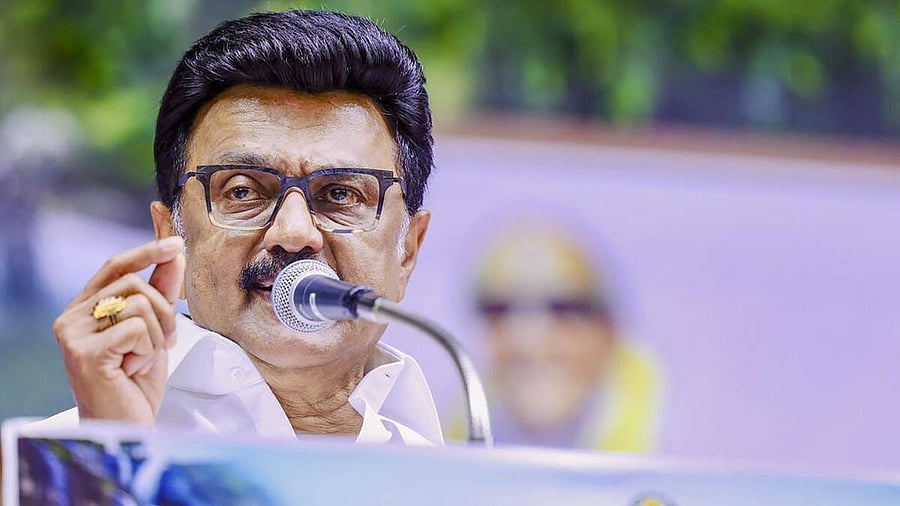
Tamil Nadu CM MK Stalin.
Credit: PTI
Chennai: Anti-Hindi agitations in the 20th century have been a cornerstone of Tamil Nadu politics, helping offshoots of the legendary Dravidian movement attain power and dominate the state’s political landscape since 1967.
As the state witnesses a renewed debate on the three-language policy, Chief Minister M.K. Stalin on Monday released ‘Anti-Hindi Agitation – Complete Government Documents’, a compilation providing a comprehensive inventory of documents chronicling the anti-Hindi imposition struggles in Tamil Nadu from 1927 to 1967.
The timing of this voluminous book’s release is significant, coming just months before the 2026 assembly elections and at a time when the DMK is projecting the polls as a contest between Tamil Nadu and Delhi (read: BJP). One of the biggest complaints that the DMK has against BJP is that the latter was imposing Hindi on Tamil Nadu.
Officials said the book serves as a comprehensive inventory of documents chronicling the anti-Hindi imposition struggles in Tamil Nadu -- from 1927, when Hindi was introduced as a subject in Chennai Province schools, to 1967, when the DMK came to power. In 1968, the state officially adopted a two-language policy of Tamil and English.
They said the book contains documents on the continuous efforts by the then Union and state governments to enforce compulsory Hindi, and the resistance led by the Self-Respect Movement, Dravidian Progressive Federation, Tamil associations, school and college students, and Tamil enthusiasts to thwart these efforts.
“The documents also include police actions to suppress the protests; details of those killed, self-immolated, or injured; damage to public property; killed policemen; attacks on police; discussions in the Legislative Assembly and Council related to the anti-Hindi agitation; secret documents; and orders to destroy secret documents,” an official said.
These are chronologically compiled records from the public works, law, and education departments.
The book also includes poignant details such as the deaths of people who passed away while incarcerated for participating in the agitation; accounts of those who self-immolated for its success; and attacks on students in various towns, including firing incidents and fatalities.
The first anti-Hindi agitation in Tamil Nadu began in December 1937 and lasted until February 1940, after the then Chief Minister of Madras Presidency, C Rajagopalachari, issued an order making Hindi compulsory in schools.
The agitation, spearheaded by Tamil writer Maraimalai Adigal and Dravidian legend E V Ramasamy Periyar, saw 1,271 people sent to prison and was withdrawn only after the order was revoked by then Governor Lord Erskine.
The next round of agitation against Hindi imposition took place in 1948 in independent India, after the cabinet led by Omandur Ramasamy Reddy made Hindi compulsory.
The third agitation against Hindi imposition occurred between 1964 and 1965, after Parliament passed the Official Languages Act according Hindi the sole official language status.
The atmosphere was so charged that at least half a dozen people immolated themselves to “save” Tamil. The protests, led by students, turned violent, with about 60 people, including two policemen, losing their lives.
The protests ended only after the then Congress government at the Centre promised to amend the Official Languages Act to ensure English’s continuation as an official language.