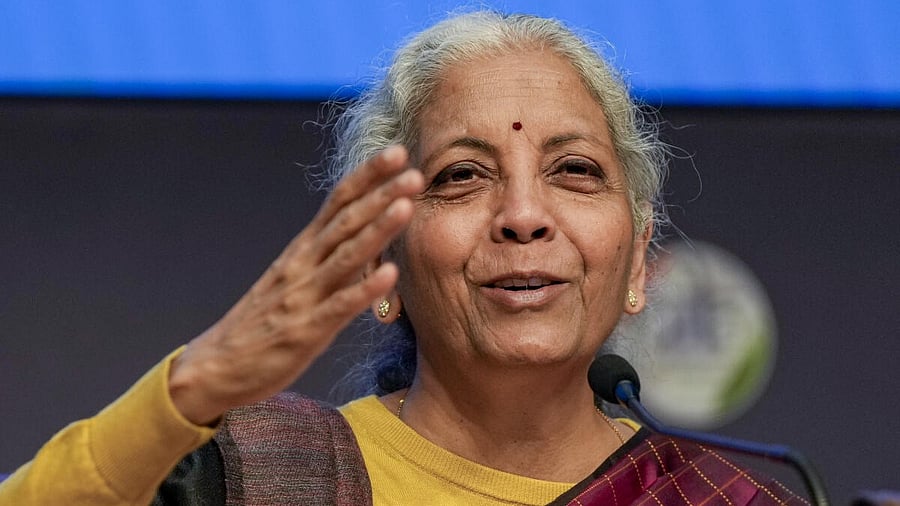
Union Finance Minister Nirmala Sitharaman.
Credit: PTI
New Delhi: In her record ninth consecutive Budget presented on a Sunday, Union Finance Minister Nirmala Sitharaman chose heavy lifting on capex to keep the growth momentum on track, support manufacturing and shore up rupee by encouraging capital inflows, but avoided any major tax-related changes and populist announcements linked to upcoming Assembly elections.
Custom duty on a range of items, including imported raw materials for manufacturing of aircraft and nuclear power projects, have been slashed amid continuing global trade tensions.
Tariff on all dutiable goods imported for personal use is proposed to be reduced from 20% to 10%.
The move may send a positive signal to US President Donald Trump, who has been pressing India for lowering tariffs on American products.
The Budget does not offer any fresh bonanza for taxpayers. Instead, the finance minister proposed to increase Securities Transaction Tax (STT) on futures trading and options.
This triggered a sharp sell-off in the stock market, with benchmark Sensex and Nifty slumping by close to 2%.
Amid concerns over capital outflows, which have pulled rupee down to record lows, Sitharaman proposed a number of initiatives to ease inflow of foreign money.
Investment limit for entities under the Persons Resident Outside India scheme (PROIs) is proposed to be hiked to 24% from 10% of their paid-up capital, and the individual investment limit to 10% from 5%.
The Budget also places a significant focus on the “New Economy” by prioritising frontier technologies like Artificial Intelligence (AI), the “Orange Economy” (creative industries), and strategic manufacturing sectors such as semiconductors and biopharma.
Key initiatives include the launch of India Semiconductor Mission (ISM) 2.0 with an outlay of Rs 40,000 crore and a tax holiday for setting up data centres in the country. Foreign companies providing cloud services using data centres located in India will not be required to pay taxes till 2047.
The minister also announced setting up a high-powered committee to review the impact of new technology like AI on the services sector, which contributes around 55% to the country’s GDP.
"The committee will prioritise areas to optimise the potential for growth, employment and exports," the finance minister said.
India targets to emerge as a global leader in services, with a 10% global share by 2047.
The finance minister also announced a comprehensive review of the Foreign Exchange Management Act (FEMA) to create a more contemporary user-friendly framework for foreign investors.
Capital expenditure (capex) of the Central government is proposed to be increased to Rs 12.2 lakh crore in 2026-27, around 9% higher from Rs 11.2 lakh crore budgeted for the current financial year. Allocations to defence and railways have been significantly boosted.
High-speed rail corridors will be developed in all four directions of the country in line with the Mumbai-Ahmedabad bullet train project. Bengaluru will be connected to Hyderabad and Chennai through bullet trains. Other cities, which are proposed to be connected through the corridors are Pune, Delhi, Varanasi and Siliguri.
“The Budget reinforces confidence in India’s growth story at a time when global economic conditions remain uncertain and investment decisions are increasingly driven by policy clarity and long-term predictability,” said Rajiv Memani, President, Confederation of Indian Industry (CII).
Technology, manufacturing and reforms dominated Sitharaman’s 85-minute budget speech, which was delivered in Parliament for the first time on a Sunday.
Despite Assembly elections due in several states, including West Bengal, Tamil Nadu and Kerala, the finance minister chose to stick to the fiscal glide path. Fiscal deficit, the amount by which the Union government’s expenditure exceeds its revenue, is proposed to be reduced to 4.3% of GDP in FY27 from the estimated 4.4% in the current financial year.
Debt-to-GDP ratio is proposed to be lowered from 56.1% in the current financial year to 55.6% in the fiscal beginning April 2026 and further to 50% by 2030-31.
Sitharaman claimed that India’s economic trajectory has been marked by stability, fiscal discipline, sustained growth and moderate inflation. “This is the result of conscious choices we have made, even in times of heightened uncertainty and disruption,” she said.
She added the government has “decisively and consistently chosen action over ambivalence, reform over rhetoric and people over populism”.
PM Narendra Modi said the Budget would give a fresh momentum to the reform push. “This is such a unique Budget in which there is a focus on reducing the fiscal deficit and controlling inflation, and along with this, there is a coordination of high capex and high growth in the budget.”
However, the Opposition criticised the Budget, terming it disappointing and lacking substance. Congress President Mallikarjun Kharge said the Budget “does not provide a single solution to India’s many economic, social, and political challenges”.
“Youth without jobs. Falling manufacturing. Investors pulling out capital. Household savings plummeting. Farmers in distress. Looming global shocks - all ignored,” Leader of Opposition in the Lok Sabha Rahul Gandhi posted on X.