
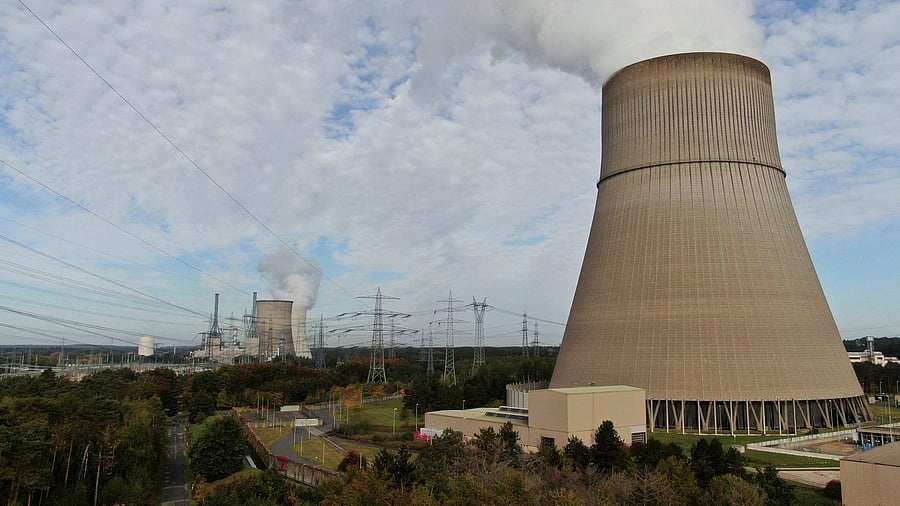
Representative image of a nuclear power plant.
Credit: Reuters Photo
New Delhi: The Union Cabinet on Friday approved a ground-breaking bill seeking to open up the closely guarded civil nuclear power sector for private players that will have to play a larger role as India eyes 100 GW of nuclear power by 2047.
Named Sustainable Harnessing and Advancement of Nuclear Energy for Transforming India (SHANTI) Bill, the draft legislation might be introduced in the Parliament next week, sources said.
The cabinet decision on opening up the nuclear sector comes 11 months after Union Finance Minister Nirmala Sitharaman made such an announcement in her budget speech.
For decades the Department of Atomic Energy, several units under the DAE and public sector undertaking Nuclear Power Corporation of India Ltd dominated India’s nuclear power landscape. There was a legal blockage restricting the entry of private companies.
For private participation, the existing Atomic Energy Act, 1962 and Civil Liability for Nuclear Damage Act, 2010 need to be revised for regulating firms outside the government while ensuring international quality safety and security standards.
It is not clear at the moment whether the SHANTI bill will cater to all areas covered by the two existing laws or a second bill would be needed.
A decade ago, the Atomic Energy Act was amended to allow joint ventures among government companies to build, own and operate nuclear power plants. The first JV was inked between NPCIL and National Thermal Power Corporation.
The first NPCIL-NTPC plant would be a 2,800 MW unit at Mahi Banswara in Rajasthan whose foundation stone was laid by Prime Minister Narendra Modi in September. The plant will house four pressurised heavy water reactors of 700 MWe capacity each and the first one will be ready in the next six and half years.
With India eyeing 100 GW of nuclear power by 2047, nearly 50% of the capacity is to come from the private sector. This will require a robust financial model that includes government incentives, viability gap funding, and sovereign guarantees to attract both domestic and foreign investments. The new law is expected to encourage private investment in N-power generation.
The bill comes at a time when scientists and engineers at Bhabha Atomic Research Centre and NPCIL have been working together to develop the first batch of small modular reactors that are considered the next big technology in nuclear power.
In 2020, the Narendra Modi government opened up the space sector triggering a massive growth of start-ups manufacturing satellites, rockets, engineering products and applications.