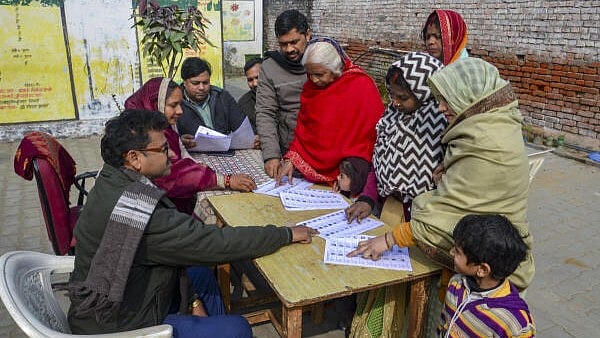
People search for their names in the draft voter list after the Special Intensive Revision of electoral rolls in Uttar Pradesh.
Credit: PTI Photo
Lucknow: Contrary to the apprehensions expressed by the opposition parties, the districts having sizeable Muslim population have witnessed lesser deletions compared to the other districts in the post-SIR draft electoral roll for Uttar Pradesh published by the Election Commission on Tuesday.
A total of 2.89 crore names have been struck off the electoral roll in UP during the SIR(Special Intensive Revision) owing to a variety of factors, including deaths, migration, duplicates and others.
A scrutiny of the district wise deletions reveals that the percentage of deletions in Saharanpur, Muzaffarnagar, Moradabad, Amroha, Rampur, Bijnore, Bulandshahar, Aligarh, Azamgarh and Mau was much less that the deletions in Lucknow, Ghaziabad and some other districts.
While Lucknow and Ghaziabad witnessed 30 per cent and 28 per cent deletions respectively, in contrast Saharanpur and Muzaffarnagar districts, which have a sizeable Muslim population, witnessed a little over 16 per cent deletions.
Similarly Bulandshahar and Aligarh districts also saw a little over 15 and 18 per cent deletions.
The deletions in Rampur, Bijnore, Amroha, Azamgarh and Mau were also below 20 per cent.
Although the opposition parties continued to claim that The SIR was aimed at removing the names of Muslim and Dalit voters and giving the BJP advantage in the polls, the figures, though they don’t reveal the numbers community wise, do indicate that it is the BJP which should be worried more than the opposition.
The BJP leaders, including Chief Minister Yogi Adityanath had expressed concern over reports that a large number of urban voters, considered to be the core voters of the saffron party, had preferred to get enrolled on the basis of their addresses in their native villages instead of the cities.
Adityanath also held a series of meetings with the party workers to discuss the matter and also asked the party ministers, MPs and MLAs to reach out to the urban voters and persuade them to not to shift their voting addresses to their villages.
BJP leaders had apprehended that the party’s electoral prospects might be impacted by such a scenario as the urban voters might not travel to their villages to exercise their franchise during the polls.