
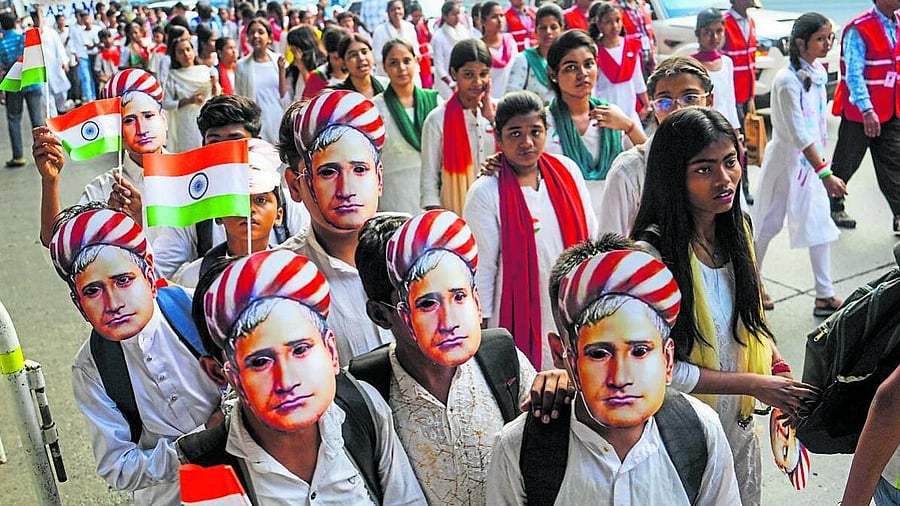
A file photo of school students wearing masks of Bankim Chandra Chatterjee taking part in the Vande Mataram Walk organised to celebrate 150 years of the national song, in Kolkata.
Credit: PTI File Photo
A special discussion on the 150th anniversary of 'Vande Mataram' will take place in the Lok Sabha on Monday. The discussion, to be initiated by Prime Minister Narendra Modi, is expected to highlight many important facets of the national song, which is one of the most debated symbols of India’s freedom struggle.
The Lok Sabha has allocated 10 hours for the 'Discussion on the 150th anniversary of national song Vande Mataram' on Monday.
Home Minister Amit Shah will begin the discussion on the national song in the Rajya Sabha on December 9.
Modi is also likely to highlight the contribution of the song, written by Bankim Chandra Chatterjee and first published in the literary journal Bangadarshan on November 7, 1875, to the freedom struggle, its historical significance and current relevance.
Renewed sparring
The discussion comes at a time when political sparring over the evolution of the song, the religious imagery in it and decision taken by the national leadership in the pre-independence India has renewed.
The BJP on Sunday said the discussion would yet again “expose” former Prime Minister late Jawaharlal Nehru.
“When there will be a debate on Vande Mataram in Parliament tomorrow, I feel that the reality of Nehru ji will be revealed to everyone; he will again be exposed,” BJP MP Sambit Patra told reporters on Sunday.
The Congress tried to "end" the legacy of leaders like Sardar Vallabhbhai Patel, Bhimrao Ambedkar and Subhash Chandra Bose just to keep Nehru's legacy alive, Patra, BJP national spokesperson, charged and asked Congress parliamentary party chairperson Sonia Gandhi to stop promoting the Nehru-Gandhi family.
This came in response to Sonia Gandhi's allegation that the ruling dispensation's main objective is to vilify the country's first Prime Minister.
Modi's charges and Congress rebuttal
Modi's thoughts about Vande Mataram are keenly awaited by the Opposition members, as during an event to commemorate the song's anniversary last month, he accused the Congress of "removing important stanzas" from the original song in the 1937 session of the party in Faizabad.
Modi had said that the Congress' decision sowed the seeds of Partition and dissected the national song into pieces. The Congress, however, claimed the decision was based on the advice of Rabindranath Tagore and amounted to the accommodation of feelings of members from other communities and faiths.
The Prime Minister had “insulted” both the Congress Working Committee (CWC) and Tagore, whose advice had shaped the decision to retain only the first two stanzas of the national song for official use, Congress general secretary (communications) Jairam Ramesh had said.
"Three days before the meeting, on October 26, 1937, Tagore wrote to (Jawaharlal) Nehru on this issue. It was the Gurudev himself — with his own special relationship to Vande Mataram — who suggested that the first two stanzas of the song be adopted. His letter, in fact, profoundly influenced the resolution in its entirety," Ramesh said in a post on X.
The CWC noted that the first two stanzas were already the only widely sung and nationally recognised part, while the remaining stanzas contained religious imagery that some citizens objected to, the Congress pointed out.
"The Prime Minister is now accusing the Gurudev of harbouring a 'divisive ideology'. It is a shameful statement from a man whose lies and distortions have no limits. The people of India demand an unconditional apology," he said.
On Monday, apart from Modi, Defence Minister Rajnath Singh is likely to participate in the discussion, while from the Congress, Priyanka Gandhi Vadra and Gaurav Gogoi are set to counter the narrative.
The Opposition parties, including the Congress, the Trinamool Congress and the Samajwadi Party, may counter the ruling party's narrative by pointing to what they describe as the RSS’ limited role in the freedom struggle.