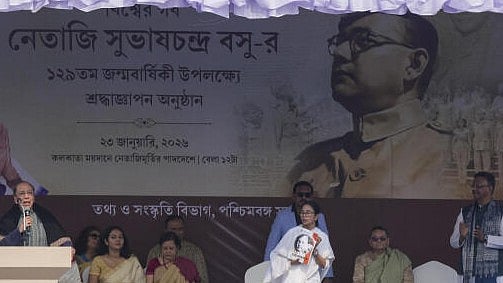
West Bengal Chief Minister Mamata Banerjee, third right, during an event marking the birth anniversary of Netaji Subhas Chandra Bose, in Kolkata
Credit: PTI Photo
Kolkata: With the 2026 West Bengal Assembly elections barely months away, the ruling TMC and the opposition BJP on Friday mounted parallel attempts to appropriate the legacy of Netaji Subhas Chandra Bose, weaving the icon's birth anniversary into the political battle over the ongoing SIR of electoral rolls.
From the state government's official programme in central Kolkata to BJP rallies and marches across the southern part of the city, Netaji's name and his 129th birth anniversary became a contested political terrain, with the SIR emerging as the newest fault line in the state's polarised electoral discourse.
Addressing a state government-organised event on Red Road, Chief Minister Mamata Banerjee launched a frontal attack on the Election Commission and the Centre, questioning whether Netaji himself would have been summoned for "hearings" under the ongoing voter list revision exercise.
"Had Netaji been alive, they would have called him for the SIR hearing too. This is their nature," Banerjee said, referring to notices issued to Netaji's grand-nephew Chandra Kumar Bose and others during the SIR process.
Without naming the BJP, Banerjee accused the Centre and the Election Commission of unleashing fear among ordinary citizens, claiming over 100 deaths linked to "panic" caused by the exercise.
"This is a fight between humanity and barbarism, between the Pandavas and the Kauravas," she said, drawing ideological parallels between the present political moment and the freedom struggle, while invoking Netaji's slogan of resistance and issuing a symbolic "Dilli Chalo" call.
Banerjee also renewed her long-standing demand for January 23 to be declared a national holiday, accusing the Centre of disrespecting India's freedom fighters and attempting to "rewrite history". She criticised the replacement of the Planning Commission, which she said Netaji had conceptualised, with the NITI Aayog, calling it an institution "no one knows whether it eats or thinks".
The TMC's attempt to position Netaji as a symbol of resistance against what it describes as an authoritarian Centre acquired an additional political layer when Chandra Kumar Bose, once Bengal BJP's state president and Banerjee's opponent in the 2016 polls from Bhabanipur assembly seat, shared the stage with the chief minister and urged her to emerge as a "national leader".
"I am requesting Mamata Banerjee not just to think as the chief minister of Bengal but as a leader of the country. Netaji's ideals alone can protect India," Bose said, underlining the shifting political alignments ahead of the polls.
The BJP, however, countered the narrative with its own symbolic mobilisation around Netaji's legacy.
Leader of the Opposition Suvendu Adhikari led a march in Bhabanipur from the house of Syama Prasad Mookerjee to Netaji's Elgin Road residence, and accused the state government of reducing Bose' birth anniversary to a "stage-managed spectacle".
Adhikari alleged that garlands he offered at Netaji's statue were removed by Public Works Department officials after he left the area, a charge the state government did not immediately respond to.
"Even programmes to celebrate Netaji's birthday are not spared political intolerance," Adhikari said, asserting that the TMC was attempting to monopolise the freedom fighter's legacy for electoral gain.
State BJP president Samik Bhattacharya said that family members of Netaji have been summoned not by design, but because, he alleged, "deliberately wrong entries" were made by officials "working under TMC pressure" to manufacture discrepancies and politically exploit public distress.
"People are being harassed so that the TMC can convert the fear into votes," Bhattacharya said.
Prime Minister Narendra Modi, meanwhile, paid floral tributes to Netaji in Delhi, underscoring the Centre's parallel efforts to project its own custodianship over the nationalist icon's legacy.
As the SIR continues to roil Bengal's political landscape, Netaji's birth anniversary has become more than a commemorative occasion, evolving into a platform for competing narratives on nationalism, democracy, institutional authority and historical ownership.
With elections approaching, the battle over Netaji's legacy appears set to intensify, mirroring the broader struggle for political legitimacy and moral high ground in a state where history, identity and the ballot are increasingly inseparable.