
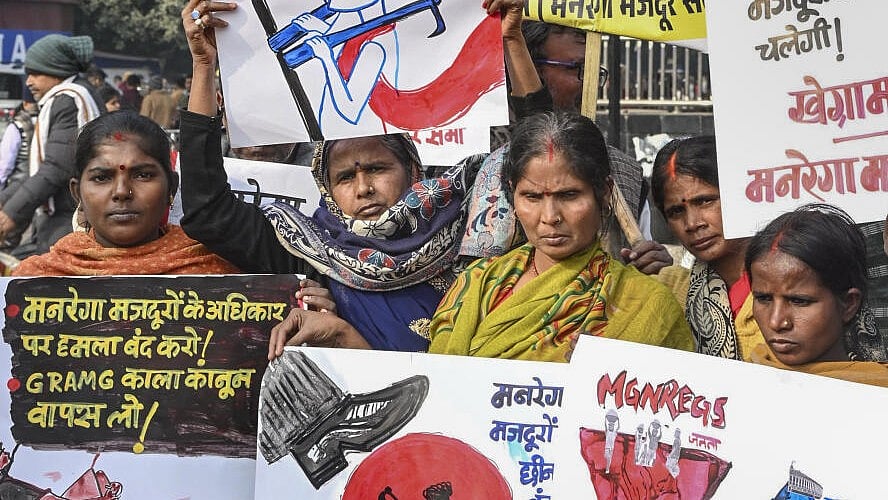
All India Agricultural Workers' Union members stage a protest against the central government replacing the MGNREGA with Viksit Bharat Guarantee for Rozgar and Ajeevika Mission (Gramin) (VB-G RAM G) Bill.
Credit: PTI
New Delhi: A group of women activists has asked the government to hold wider public discussion on ‘VB-G RAM G Act 2025’ before formulating rules for its implementation, claiming that there is a “very real risk” that it may fail to provide 125 days of employment and could make harder for women, SCs and STs to secure jobs where and when they need it most.
Finding fault with the transformation of a legally binding entitlement guaranteeing employment for the most vulnerable to a budget-capped government scheme, the ‘Feminist Policy Collective’ (FPC) claimed that the expectation of 40% expenditure by states would create hurdles in the implementation of the new job guarantee scheme itself.
It also raised concern over halting the job scheme during peak farming seasons, saying that it takes away the choice of poor rural workers – especially women, SCs, and STs – exposing them to “exploitation by large landowners and diminishing bargaining power”. This will “push rural and farm wages downward while further driving down gender wage parity,” it said.
President Droupadi Murmu has given her assent to 'Viksit Bharat - Guarantee for Rozgar and Ajeevika Mission (Gramin): VB - G Ram G Act 2025', which replaces MGNREGA 2005, on Saturday, two days after it was passed in Parliament.
“While VBGRAMG rhetorically promises to increase employment from 100 to 125 days...this however, will depend entirely on the central government’s allocation of budget...The very real risk is that the central government’s allocations may not provide 125 days of guaranteed employment,” it said. Only 7% households were able to complete 100 days of employment in recent times.
The FPC, a voluntary group looking at transformative financing for gender justice, recalled that MGNREGA has generated 286.18 crores of person-days in 2024-25, supporting 5.78 crore households and providing employment to 7.88 crore individuals. The impact on social justice is evident from the fact that 58% of the beneficiaries of MGNREGA are women, 18% are SC and 18% are from ST communities, it said.
The FPC warned that centralisation makes access to guaranteed employment harder for women workers, especially those unable to travel outside their villages, thereby weakening inclusivity. By linking rural employment schemes to large infrastructure projects under PM Gati Shakti, it said, the Act risks sidelining small-scale, unskilled rural employment.
With digital connectivity a concern in rural areas, they also said the reliance of technology risks excluding rural communities and weakens the accessibility of employment guarantee programmes.
The group said the MGNREGA allowed the Gram Panchayats to select the works to be done but this has now become “doubtful” since the Act “significantly alters decentralized micro-planning by reducing the autonomy” of gram panchayats.